Saltwater Aquarium Shrimp: Choosing Compatible Species
Choose saltwater shrimp by matching the identified species to your aquarium’s inhabitants, available shelter and feeding routine. Skunk cleaner shrimp and fire shrimp are useful starting points for comparison in an established reef, but neither is an automatic fit. Burrowing species need a suitable layout, while specialized feeders can create substantial ongoing commitments.
“Reef-safe” is only a starting question. A shrimp might leave coral tissue alone yet compete for offered food, threaten another invertebrate or become prey itself. Before buying, decide whether your aquarium can support the animal throughout its adult life—not simply accommodate its purchase size.
This guide compares living ornamental marine shrimp commonly considered for home aquariums. Their requirements differ enough that one stocking formula or universal water-parameter range would be misleading.
Table of Contents
What “reef-safe shrimp” should mean
Evaluate five separate questions:
- Direct harm: Could the shrimp consume or injure a coral, worm, sea star, fish or another shrimp?
- Feeding interference: Could it take food intended for a slower animal or repeatedly interrupt feeding?
- Risk to the shrimp: Could existing livestock hunt, harass or exclude it from shelter?
- Environmental compatibility: Can all inhabitants thrive under the same temperature, salinity, flow and other conditions?
- Usable habitat: Is there sufficient shelter, feeding access and room for territorial or burrowing behavior?
A label cannot resolve these questions without species identities and aquarium context. Likewise, finding a shrimp eating remains does not establish that it killed the animal. Scavenging, predation and interference with feeding are different interactions.
Marine aquarium shrimp types: an at-a-glance comparison
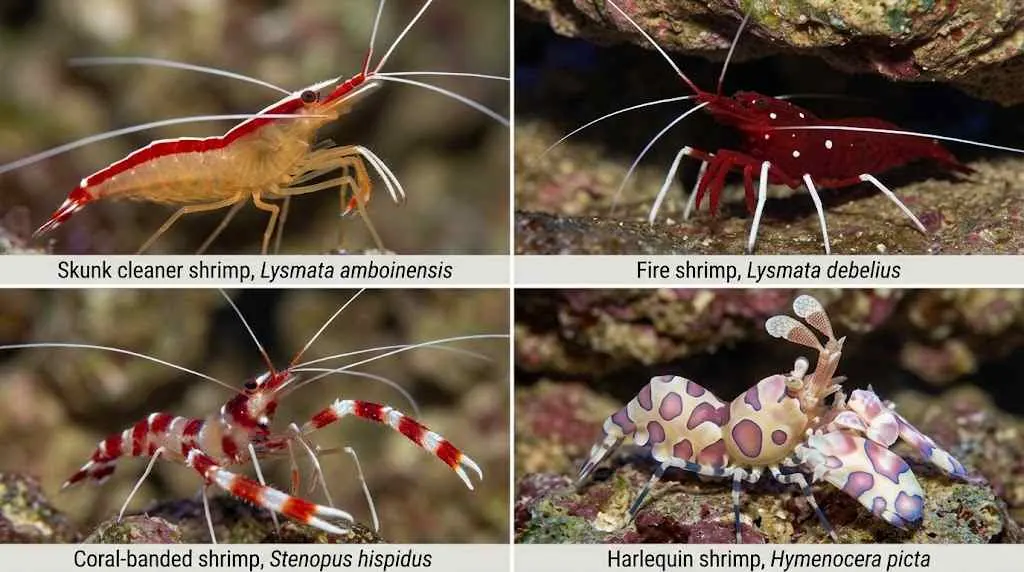
Reported lengths below are approximate body dimensions, not antenna-tip-to-antenna-tip spans. Where a defensible single figure would obscure identification or husbandry differences, the table gives the more useful space consideration.
| Common and scientific name | Adult size or space consideration | Feeding approach | Habitat or social considerations | Main compatibility question | May suit |
|---|---|---|---|---|---|
| Skunk cleaner shrimp, Lysmata amboinensis | About 5–6 cm (2–2.4 in); antennae extend farther | Accepts prepared foods; also performs cleaning behavior | Rock crevices and ledges; assess additional cleaners carefully | Predatory fish, food access and aggression within crowded groups | Keepers wanting an ornamental cleaner with a planned feeding routine |
| Fire shrimp, Lysmata debelius | About 5 cm (2 in), excluding its long antennae | Offered aquarium foods; cleaning behavior should not be its food plan | Sheltered caves and overhangs; territories matter | Whether it can shelter and feed without harassment | Keepers comfortable with a potentially concealed display animal |
| Peppermint shrimp, Lysmata spp.; confirm the actual species | Adult dimensions depend on identity; a generic shop label is insufficient | Scavenging and offered foods; some are used against Aiptasia | Crevices and accessible feeding areas | Identity, actual feeding behavior and interactions with valued invertebrates | Keepers willing to verify stock rather than buy a pest-control promise |
| Randall’s pistol shrimp, Alpheus randalli | Burrow footprint and excavation matter more than its small body alone | Food must reach the shrimp around its burrow | Appropriate substrate, secure rockwork and a verified goby association if planned | Burrowing disturbance and the suitability of both partners | Aquarists designing specifically for burrowing behavior |
| Coral-banded shrimp, Stenopus hispidus | Reported to about 6.2 cm (2.4 in); claws and antennae increase its reach | Animal foods; also documented cleaning behavior | Territorial shelter use; established pairs are different from arbitrary combinations | Other crustaceans, small invertebrates and contested shelter | Keepers able to accommodate its territory and monitor interactions |
| Harlequin shrimp, Hymenocera picta | About 5 cm (2 in); food provision is the larger commitment | Specialized sea-star feeding | Requires a sustainable, continuing food plan | Incompatible with sea stars intended as display animals | Prepared specialist keepers |
Cleaner shrimp: choose the animal, not a treatment claim
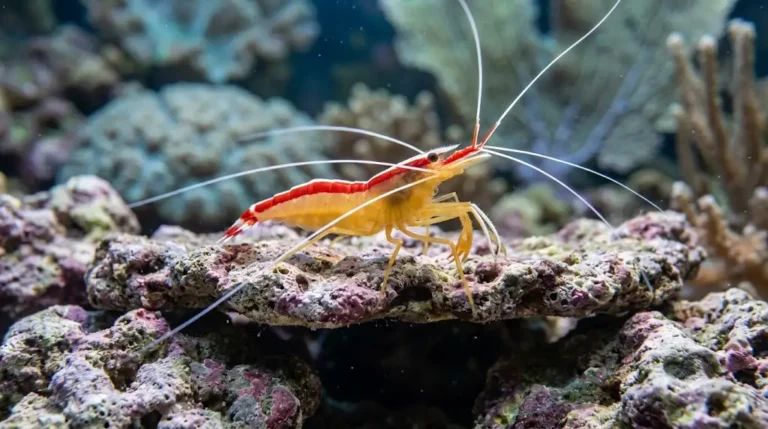
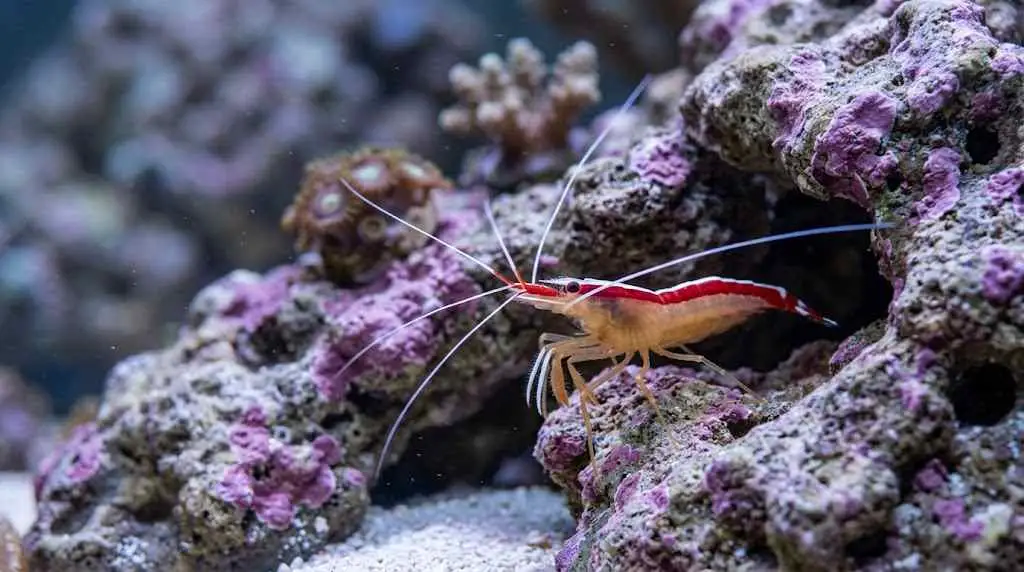
The skunk cleaner shrimp, Lysmata amboinensis, appeals to aquarists because of its contrasting stripes, long antennae and interactions with visiting fish. It uses reef ledges and crevices as shelter and cleaning locations.
Plan to feed it directly. Prepared pellets and suitable frozen foods are accepted aquarium options; the presence of fish does not establish that cleaning supplies adequate nutrition. Confirm what the individual currently eats and how you will deliver food past competing fish.
Cleaning is a documented behavior, but buying a cleaner is not a disease-management plan. Research has demonstrated consumption of particular parasite stages and reduced infection under defined experimental conditions. Those results do not establish that every fish will accept cleaning or that shrimp eliminate every aquarium pathogen. Continue appropriate quarantine, diagnosis and treatment when needed.
For detailed habitat and feeding guidance, see cleaner shrimp care and reef compatibility
Fire shrimp: plan for shelter and feeding access
Fire shrimp, Lysmata debelius, offer strong red coloration with white markings, but visibility should not be the purchase criterion alone. Provide caves or overhangs where the animal can remain sheltered rather than expecting continuous activity across exposed rock.
Accounts differ in how they describe activity timing. A useful practical expectation is that the shrimp may spend substantial time concealed, with behavior varying by individual and aquarium. Confirm that offered food reaches its chosen shelter.
Do not assume that adding another fire shrimp solves hiding or feeding concerns. Captive-rearing work describes territorial aggression involving established pairs, reinforcing the need to assess social arrangements rather than combine animals casually.
See fire shrimp habitat, feeding and compatibility — Fire Shrimp Care: Habitat, Feeding and Compatibility] before purchase.
Other marine shrimp options
Peppermint shrimp: identification comes first
“Peppermint shrimp” covers several similar-looking Lysmata species. A study of aquarium shops in the southeastern United States identified Lysmata boggessi in stock commonly understood or labeled to be L. wurdemanni. That finding applies to the study’s market and sampling period; it does not identify every peppermint shrimp sold elsewhere.
Ask for the scientific name, source and feeding history. A generic photograph or red-striped appearance may not settle the identification.
Peppermint shrimp are marketed for consuming Aiptasia, and aquarium producers report this behavior in their stock. Treat it as a potential contribution, not a promised clearance service. Confirm the target organism, assess interactions with your particular corals and invertebrates, and maintain a feeding plan after the target food declines.
Pistol shrimp: select a partnership and a habitat
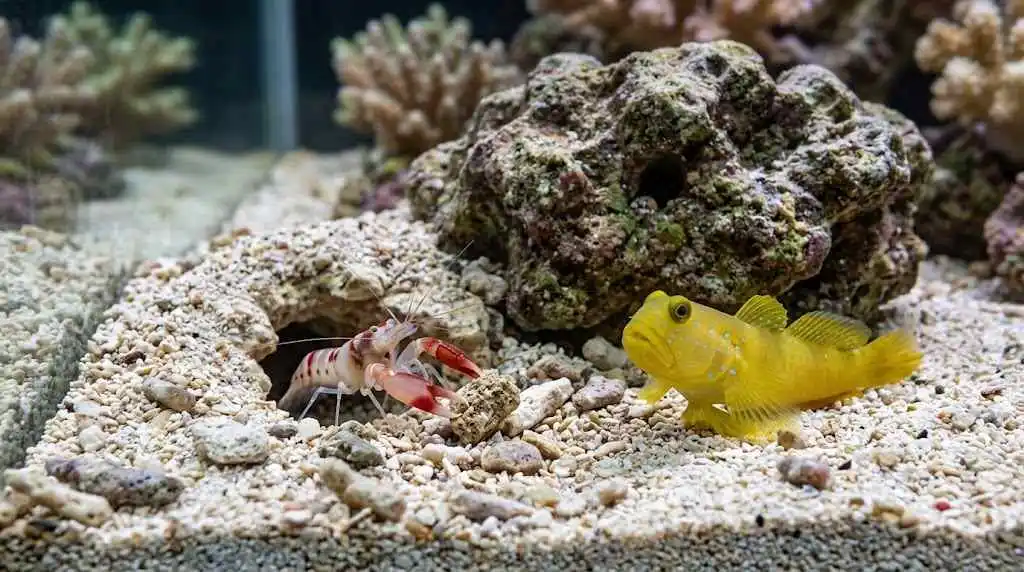
Randall’s pistol shrimp, Alpheus randalli, is a burrow-associated species documented sharing shelter with gobies. The shrimp maintains the burrow while the fish contributes vigilance. This relationship is an important reason to choose it, but “pistol shrimp” and “goby” are not sufficiently precise shopping instructions.
Research shows that partner associations depend partly on species and habitat. Confirm a documented match; do not expect any two animals bearing these broad labels to form a partnership.
Plan for excavation: secure rockwork independently of loose sand and consider nearby sand-level corals. Confirm that you can observe feeding around the burrow without dismantling the habitat.
Coral-banded shrimp: allow for territorial behavior
Stenopus hispidus combines conspicuous banding with large claws and long antennae. It has documented cleaning behavior, but its diet also includes other marine invertebrates. Territorial behavior makes “another cleaner shrimp” an inadequate compatibility assessment.
Assess smaller crustaceans, valuable worms and existing shelter occupants individually. An established compatible pair is not equivalent to two newly purchased animals. Choose this species only when its territory and feeding needs fit the intended community.
Harlequin shrimp: food supply determines suitability
Hymenocera picta is a specialized sea-star predator. Research on its captive maintenance has addressed the challenge of supplying suitable sea stars, including concerns about dependence on wild-collected food animals.
A temporary population of small nuisance stars is not a long-term feeding plan. Before purchase, establish an appropriate continuing food source and account for its cost, availability and husbandry demands. Do not assume ordinary fish food will replace that commitment.
This species is unsuitable when valued sea stars are part of the display. If the food plan remains uncertain, postpone the purchase.
A saltwater shrimp compatibility checklist
Work through these steps before deciding:
- Confirm identity and adult dimensions. Include appendage reach and burrowing or territorial space.
- Review aquarium records. Check measured conditions and their consistency, including changes during evaporation and maintenance.
- Compare species requirements. Shared survival limits do not necessarily describe conditions in which all inhabitants can thrive.
- Map usable shelter. Identify where the shrimp could retreat, molt and feed without entering an occupied territory.
- Review every tankmate. Consider adult size, diet, hunting behavior and access to the shrimp’s shelter.
- Plan food delivery. Confirm that the shrimp can obtain an appropriate diet despite competition.
- Prepare monitoring and separation options. An inaccessible shrimp in complex rockwork can be difficult to remove after conflict begins.
Use a suitable marine instrument when checking salinity. Salinity, specific gravity and freshwater TDS readings are not interchangeable labels.
Nominal aquarium volume cannot answer all these questions. For a small system, consult nano reef planning and stability — Nano Reef Tank Setup: Planning a Small Marine Aquarium]. That guide does not make every species above appropriate for a nano reef.
Compatibility with fish, corals and other invertebrates
Fish can be clients, competitors or predators
Assess the particular fish rather than relying on “community” or “reef-compatible” descriptions. A fish that leaves corals alone may still eat crustaceans. Cleaner-shrimp husbandry guidance specifically flags predatory tankmates as a concern; broad fish groups still require species-level assessment.
Natural cleaning interactions do not justify testing an otherwise unsuitable predator–prey combination. Nor does feeding the fish more heavily remove the concern.
Coral contact needs interpretation
Watch what happens during feeding. Distinguish a shrimp taking an offered morsel, walking across tissue or scavenging damaged material from confirmed consumption of healthy coral tissue.
Repeated interference can matter even without direct predation. If a coral repeatedly loses food, adjust delivery or the arrangement and verify that both animals actually feed. Do not assume adding more food throughout the aquarium resolves an access problem.
Mobile and attached invertebrates need separate checks
Sea stars, ornamental worms, snails and other crustaceans do not share one risk profile. Harlequin shrimp illustrate this clearly: suitability around some reef inhabitants does not make them suitable companions for sea stars.
Record actual interactions rather than assigning blame from missing livestock alone. Consider hiding, equipment access, water conditions and other inhabitants during an investigation.
Keeping multiple shrimp
Research the social behavior of the exact species before adding companions.
In a controlled Lysmata amboinensis study, aggression and losses occurred in groups larger than pairs, particularly around molting. This supports caution about crowding cleaners together; it does not establish a universal stocking limit for every aquarium layout.
Before combining shrimp, check:
- Whether the species normally forms pairs, groups or defended territories.
- Whether an advertised pair has actually cohabited.
- Whether shelter and feeding areas can be used independently.
- Whether a vulnerable, recently molted animal can retreat.
- Whether separation is practical if persistent exclusion or aggression develops.
Extra hiding places help only when the underlying combination is reasonable. Buying two animals does not establish a compatible pair.
Feeding commitments and cleanup-crew expectations
Marine tank shrimp should be selected as animals with diets, not as substitutes for maintenance. Scavenging can contribute food, but leftovers vary with fish feeding, competition and the aquarium’s condition.
For generalist species, confirm accepted foods and watch delivery. A shrimp rushing toward food does not prove that it receives enough, while a concealed shrimp may require observation at another time.
Shrimp also are not interchangeable with algae-grazing snails. Compare each animal’s actual role through choosing suitable saltwater aquarium snails — Saltwater Aquarium Snails: Choosing a Suitable Cleanup Crew].
Keep cleanup expectations modest: feeding animals and processing organic material do not remove the need to manage waste.
Before buying and introducing a shrimp
Ask the supplier to confirm identity, holding conditions, current diet and recent behavior. Observe the animal where possible, including whether it can move normally and obtain food; appearance alone cannot establish health.
Prepare appropriate receiving conditions and a quarantine or observation plan suited to your system. Verify any transfer procedure against the species and transport circumstances rather than following one fixed drip-acclimation duration.
Arrange a suitable separation option before introduction. Do not rely on quickly catching the shrimp later from a fully stocked reef.
Afterward, monitor feeding access, pursuit, injury and displacement from shelter. A short period without visible conflict is encouraging but cannot establish long-term compatibility.
Example selection decisions
These situations are hypothetical.
An established reef with small fish and accessible caves: A skunk cleaner shrimp may be a candidate once the fish identities, feeding competition and receiving conditions have been checked. “Small fish” alone is insufficient evidence.
A compact marine aquarium with little free rock space: Pause before adding a territorial or burrowing species. Assess usable habitat and maintenance access first; a small purchase specimen does not resolve space limitations.
A display containing a known crustacean predator: Choose a different arrangement. Cleaning behavior, additional food or a new cave should not be used to justify exposing the shrimp.
A keeper considering a harlequin shrimp for nuisance stars: Proceed only after confirming the target and establishing a continuing species-appropriate food plan. Pest removal alone is not enough reason to buy it.
Final selection checklist
Before choosing reef aquarium shrimp, confirm:
- The scientific identity is sufficiently reliable.
- Adult size, appendage reach and habitat use fit the aquarium.
- Existing livestock are compatible with the shrimp, and vice versa.
- Coral disturbance, food competition and direct predation have been considered separately.
- Suitable food can be supplied consistently.
- Social arrangements are supported for the species.
- Monitoring and separation are practical.
- The animal remains wanted after any hoped-for cleaning or pest-control benefit ends.
Choose the species whose requirements fit the aquarium you can maintain. When identity, compatibility or food supply remains unresolved, the useful next step is to resolve that gap before purchasing.