Cleaner Shrimp Care: Feeding, Tankmates and Reef Compatibility
A cleaner shrimp can suit an established marine aquarium when it has appropriate water conditions, dependable food, protected shelter, and compatible tankmates. This guide covers the skunk cleaner shrimp, Lysmata amboinensis. Its cleaning behavior is fascinating, but it does not replace deliberate feeding or proper investigation of fish disease.
Before buying one, consider the aquarium from the shrimp’s perspective: can it reach food without being chased, retreat safely after molting, and occupy suitable habitat as an adult?
Table of Contents
Which cleaner shrimp does this guide cover?
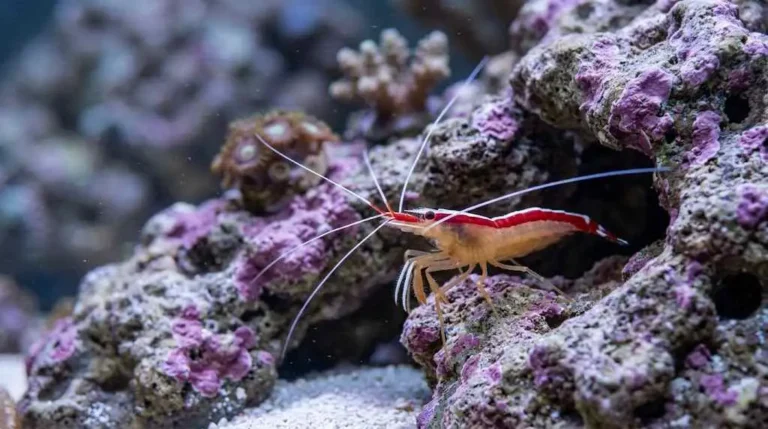
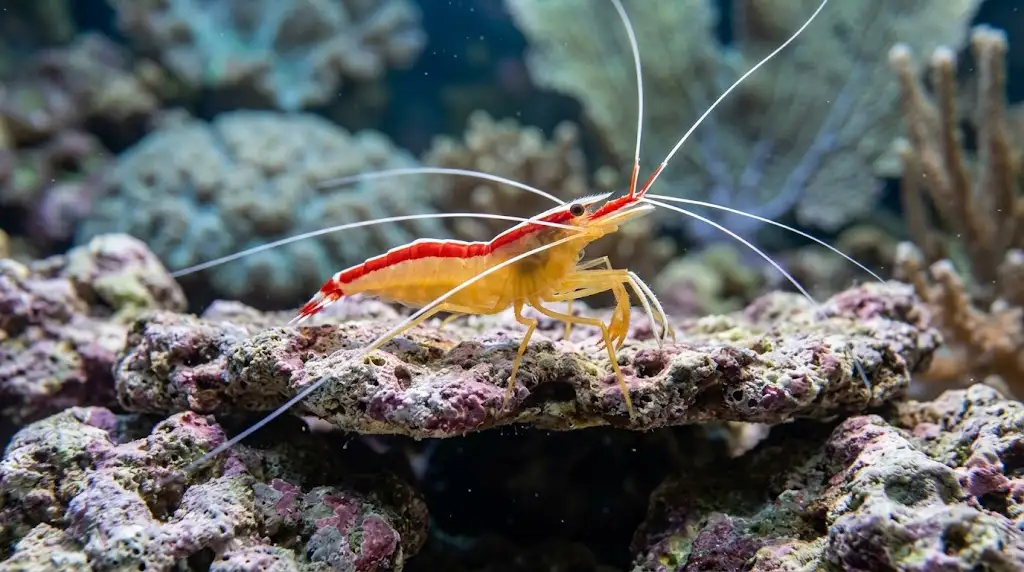
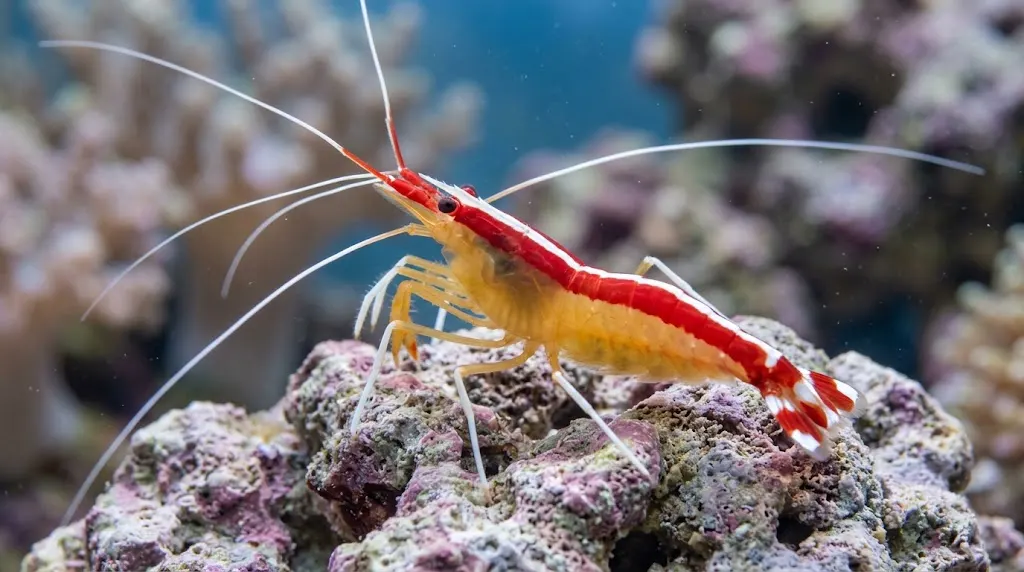
Lysmata amboinensis is an Indo-Pacific species commonly sold as a skunk cleaner shrimp, Pacific cleaner shrimp, or scarlet skunk cleaner shrimp. It has an orange-yellow body, a red dorsal area divided by a white stripe, and conspicuously long white antennae. Georgia Aquarium lists a common length of approximately 6.4 cm, or 2.5 inches; allow additional space for its antennae
The similar Atlantic species Lysmata grabhami is distinct. Tail markings help separate them: L. amboinensis has separate white patches on the outer tail fan, whereas L. grabhami has more continuous white edging. Check the scientific name and origin rather than relying on a blurred photograph or the name “skunk shrimp.”
Fire shrimp, Lysmata debelius, are another species, recognizable by their predominantly deep-red appearance and white markings. See fire shrimp habitat and compatibility [INTERNAL LINK NEEDED: RF03 — Fire Shrimp Care: Habitat, Feeding and Compatibility]. These species are separately recognized in the World Register of Marine Species.
For comparisons with other marine shrimp, use the saltwater shrimp selection guide [INTERNAL LINK NEEDED: RF01 — Saltwater Aquarium Shrimp: Choosing Compatible Species].
Cleaner shrimp care at a glance
| Care consideration | Practical guidance |
|---|---|
| Species covered | Lysmata amboinensis |
| Adult planning size | Approximately 6 cm of body length, plus long antennae |
| Aquarium suitability | Established marine filtration, suitable conditions, and compatible inhabitants |
| Habitat | Stable rockwork with accessible ledges, crevices, and protected retreats |
| Feeding | Suitable prepared marine foods and small meaty portions; verify that the shrimp receives food |
| Water conditions | Tropical marine conditions; measure temperature and salinity consistently |
| Molting | Provide refuge and avoid unnecessary handling |
| Compatibility | Assess predation, harassment, food competition, and interactions with corals |
| Stocking | One shrimp is an option; pairs need assessment, and larger groups deserve particular caution |
A tank-volume label cannot establish suitability by itself. Shelter, food access, existing livestock, and the ability to maintain conditions all matter.
Assess aquarium readiness and habitat
Choose a system with functioning biological filtration and a maintenance record you understand. A recently filled aquarium is not ready simply because the water looks clear.
Inspect the intended shelter. The shrimp should be able to perch, withdraw, and move around without entering an exposed pump intake or being forced into a dominant animal’s territory. Ledges and crevices are useful habitat features reported in species-specific husbandry guidance.
Before purchase, check:
- Whether salinity and temperature remain consistent between maintenance visits.
- Whether existing animals hunt crustaceans or defend the available rockwork.
- Whether food can reach the shrimp’s position.
- Whether there is an appropriate alternative home if compatibility fails.
Leave accessible observation areas around the shelter. A shrimp that initially hides does not automatically need a rearranged aquarium; dismantling its refuge may add disturbance without explaining the behavior.
Introduce the shrimp carefully
Ask the supplier about holding salinity, temperature, recent feeding, and transport arrangements. Prepare the destination before opening the transport container.
Arrival decisions should reflect the difference between source and destination conditions, the shrimp’s condition, and the length of transport. A fixed drip-acclimation duration cannot account for all these factors. Transport water can accumulate waste, and changes in pH and temperature affect ammonia toxicity. Those water-chemistry mechanisms matter, although fish-transport guidance is not a species-specific shrimp acclimation protocol.
If using quarantine or observation housing, provide suitable marine conditions, established filtration, and shelter. An unprepared container is not automatically a safer destination.
Do not apply a fish-medication protocol to the shrimp. Copper toxicity depends on concentration, chemical form, water conditions, and the organism exposed; the presence of a trace element is not equivalent to exposure to a therapeutic dose. Verify the exact product and setting before treatment.
Feed cleaner shrimp deliberately
Cleaner shrimp feeding should be part of the aquarium’s planned routine. Cleaning fish and collecting scraps provide variable opportunities, not a dependable ration.
Suitable options include appropriately sized marine pellets and small portions of thawed marine foods. Published husbandry references list foods such as shrimp, krill, mussel, clam, and mysis. Vary suitable foods rather than treating a single occasional scrap as a complete feeding plan.
Check consumption, not just interest
Watch what happens after food enters the aquarium. A shrimp may emerge and reach toward food while faster fish consume everything first.
Offer a small, accessible portion near its usual perch. If necessary, use a feeding tool to place food within reach without poking the shrimp or pushing food against its mouth. Allow it to approach voluntarily.
During regular feeding checks, ask:
- Did the shrimp obtain and begin consuming food?
- Was the portion carried away by another animal?
- Did it repeatedly abandon food because of harassment?
- Are uneaten pieces accumulating in the shelter?
Adjust the amount, location, and opportunity according to those observations. Food concentration, shrimp size, other feeding opportunities, and competition make one universal ration inappropriate.
If competition is the problem, try feeding at separate locations while watching both animals. Simply adding more food throughout the aquarium may increase leftovers without improving the shrimp’s access.
What cleaning behavior does—and does not—mean
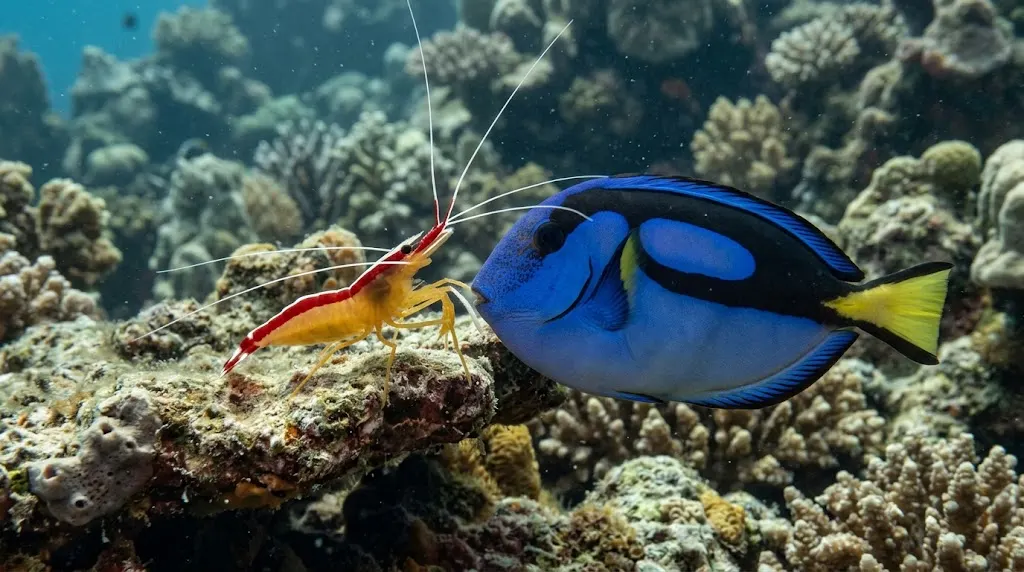
Lysmata amboinensis can establish cleaning stations and remove material from visiting fish. Whether a particular fish participates depends on the interaction; a shrimp that does not clean a particular aquarium resident is not necessarily unhealthy.
Controlled research has demonstrated reductions in certain parasites under defined experimental conditions. Results varied with parasite species, life stage, cleaner species, and time of day. This supports a biological cleaning role, not a promise to eradicate an infection in a home aquarium.
Consequently:
- Seeing cleaning does not identify the organism being removed.
- A cleaner shrimp’s presence does not prove fish are disease-free.
- Continued flashing, lesions, breathing changes, or other concerns still require investigation.
Purchase the shrimp because the aquarium can support it, not as a substitute for diagnosis or treatment.
Assess cleaner shrimp tank mates
Compatibility depends on the actual species, individual behavior, adult size, and aquarium layout.
| Inhabitant or group | Main interaction | Factors affecting risk | Practical decision |
|---|---|---|---|
| Fish that consume crustaceans | Predation | Diet, mouth size, hunting behavior, and shelter access | Avoid relying on cleaning behavior for protection |
| Otherwise compatible community fish | Food competition or chasing | Feeding speed and territorial behavior | Observe feeding and access to refuges |
| Another L. amboinensis | Pair formation, competition, or aggression | Individual interaction, shelter, and molting | Monitor both animals and retain a separation option |
| Other shrimp or territorial crustaceans | Competition for food and shelter | Species identity, size, and defended areas | Research the particular combination |
| Corals and other target-fed animals | Food theft or feeding disturbance | Feeding method and repeated shrimp visits | Observe the recipient as well as the shrimp |
Species guidance identifies predatory fish, including puffers and lionfish, as concerns. Broad labels such as “wrasse” are insufficient: assess the particular species rather than assuming every member of a group behaves identically.
One shrimp, a pair, or a group?
In a controlled L. amboinensis study, groups of three or four were reduced to pairs through aggression, with attacks associated with vulnerable post-molt individuals. Single and paired treatments did not show that mortality pattern during the experiment. The result supports caution about groups; it does not establish that every pair will coexist in every aquarium.
The species first functions as male and later develops simultaneous male and female reproductive capability. Mature partners can alternate reproductive roles, so selecting a conventional male–female pair is not the appropriate model. Self-fertilization does not occur. Egg carrying also does not mean that juveniles will develop successfully without specialized larval care.
What does reef compatibility mean?
“Reef-compatible” should describe observed interactions, not erase them.
A cleaner shrimp may walk over coral, investigate food, or take a portion intended for another animal. A public-aquarium husbandry reference reports food theft from coral polyps and possible injury during these interactions. This is a documented management concern, not evidence that every cleaner shrimp damages corals.
Watch whether the coral successfully retains food and whether repeated visits cause visible damage or persistent disruption. Brief contact and demonstrated injury are different observations.
Separate feeding locations or timing may help manage access, but supplementary feeding cannot guarantee compatibility. Persistent harmful interaction may require changing the arrangement or separating the animals.
Recognize cleaner shrimp molting
Shrimp grow by shedding their external skeleton. The newly exposed covering is initially soft, making shelter particularly important. An empty shed can retain a recognizable shrimp outline, including appendages, and may be mistaken for a dead animal.
Look for an apparently hollow shell and try to locate the living shrimp without dismantling its retreat. Transparency, posture, or one photograph cannot always establish what you are seeing.
Reduced visibility around a molt deserves context. A hidden shrimp with otherwise normal tank conditions is different from several inhabitants losing balance or becoming unresponsive.
Do not pull retained shell from a living shrimp. A molt, pale area, or suspected shedding problem also does not establish iodine deficiency. Review actual conditions, nutrition, injury, and recent changes before considering any corrective addition.
If the object’s identity is uncertain, do not handle it as waste merely because it is motionless. Confirmed remains and empty sheds require different decisions.
Maintain suitable, stable marine conditions
Record actual measurements rather than describing the water as “normal.”
For context, published L. amboinensis research maintained animals at 24–25°C, approximately 75–77°F, and salinity of 34–35 parts per thousand. These are documented experimental holding conditions, not a demonstrated optimum or complete tolerance range.
Salinity and specific gravity are related but different measurements. Salinity describes salt content; specific gravity is a density ratio. For example, Tropic Marin lists seawater at 35 parts per thousand as approximately 1.026 specific gravity at 25°C for its measurement context. Follow the instrument’s calibration and temperature instructions.
Evaporation removes water while leaving salts behind. Replace evaporative loss with suitable freshwater; replace deliberately removed saltwater with appropriately prepared saltwater. Confusing these tasks can change salinity.
Use the reef water-change planning guide [INTERNAL LINK NEEDED: RF06 — Reef Tank Water Changes: Planning and Matching Replacement Water] for preparation and matching details.
Avoid abrupt adjustments based on one questionable reading. However, stability is not a reason to ignore a confirmed hazard: failed equipment, unsuitable temperature, or a verified contamination event requires proportionate action.
Troubleshoot concerns without guessing a diagnosis
| Observation | Possible explanations | What to check | Proportionate next step |
|---|---|---|---|
| Hiding more than usual | Recent introduction, molting, disturbance, harassment, or illness | Food response, tankmates, recent events, and water readings | Observe from a distance; investigate accompanying changes |
| Not accepting food | Food presentation, competition, molt-related behavior, or impaired condition | Whether food is reachable and whether others are affected | Try accessible suitable food; investigate persistent refusal |
| Repeated food theft by tankmates | Unequal access or territorial behavior | What happens during feeding | Separate feeding locations; reassess compatibility |
| Apparent incomplete molt | Retained shell, injury, or an ambiguous view | Movement, recent changes, and actual measurements | Avoid extraction; seek qualified help for serious or persistent difficulty |
| Injury or repeated chasing | Aggression, predation attempts, or equipment contact | Direct interactions and exposed hazards | Stop the supported source of harm; separate if necessary |
| Loss soon after introduction | Transport, condition differences, prior illness, or predation | Arrival history and source/destination conditions | Investigate before replacing the shrimp |
| Several inhabitants distressed | A wider environmental or exposure problem | Equipment, temperature, salinity, and relevant water tests | Address verified hazards promptly |
For persistent or severe problems, seek an aquatic-animal veterinarian or experienced marine-invertebrate professional where available. Record observations, test units, and actions so that advice is based on more than a description of “poor water.”
Frequently asked questions
Can cleaner shrimp live without fish to clean?
Cleaning opportunities are not their only food source. An appropriately maintained marine aquarium can provide deliberate feeding without relying on fish clients. Compatibility and habitat still need assessment.
Does carrying eggs mean I need to add another shrimp?
No. Egg carrying is not a reason to change stocking. Assess the current animal’s condition and the aquarium’s capacity; successful larval rearing is a separate undertaking.
Should I move a shrimp every time it molts?
Routine transfer is unnecessary and adds handling. Provide suitable shelter in advance. Separation is a different decision when a tankmate is actively harming it or its current environment is unsafe.
How long should a cleaner shrimp live?
Published aquarium estimates vary, and a purchased animal’s age is usually unknown. Avoid treating a quoted lifespan as a guarantee or using it to diagnose a death. Evaluate husbandry, observed condition, and the circumstances of the loss.
Successful cleaner shrimp care starts with correct identification and a suitable marine aquarium. Make food access observable, provide protected shelter, monitor interactions, and respond to measured problems rather than assuming cleaning behavior makes the shrimp self-sufficient.