
Aquarium Plants for Beginners: Choosing Your First Plants
Good aquarium plants for beginners fit the aquarium you have and the work you are willing to do. For modest lighting and existing wood or rocks, Java fern and a compact Anubias are useful starting choices. For planted substrate, consider an identified Cryptocoryne variety. Add stems or floating plants when their growth and regular maintenance suit your plans.
You do not need every growth form to create an attractive aquarium. A few compatible choices are easier to position, observe and maintain than a collection selected only from photographs.
“Easy” also needs context. A plant may survive a range of conditions yet outgrow a small tank. Another may grow slowly and need little trimming but still require nutrients, appropriate light and occasional cleaning.
Table of Contents
Check your aquarium before buying
Make a short record of the conditions your plants will encounter:
- Dimensions and space: Consider height, footprint and access around equipment. Leave room for mature leaves and roots.
- Lighting: Identify the fixture, its settings and where shadows fall. A well-lit surface does not establish that the substrate receives enough light for a carpet.
- Substrate and hardscape: Decide whether you have space for rooted plants, attachment points on wood or stone, or both.
- CO₂ plans: If you do not intend to inject carbon dioxide, choose plants and growth expectations that suit that decision.
- Water conditions: Check the aquarium’s temperature, hardness and other relevant conditions against the selected plant’s requirements.
- Livestock: Identify animals that eat leaves, dig, uproot plants or repeatedly disturb planting areas.
- Surface conditions: Note filter outlets, splashing, water movement and clearance beneath the lid.
- Maintenance preference: Decide whether you prefer occasional leaf removal, regular stem trimming or frequent surface thinning.
Low light means a lower light requirement, not darkness. Tank depth, shading and fixture coverage matter more than a universal watts-per-gallon formula. Extending the lighting period is not a dependable substitute for an unsuitable fixture or planting location.
For help evaluating a modestly lit aquarium, see choosing plants for lower light — Low-Light Aquarium Plants and How to Grow Them].
If the aquarium itself is still being planned, use the complete planted-aquarium setup guide — How to Set Up a Planted Aquarium]. Adding plants does not replace cycling, water testing or livestock preparation.
Aquarium Plants For Beginners
These examples cover different planting methods and workloads. They are alternatives to compare, not a shopping list to purchase in full. The linked producer profiles support the plant-specific growing information.
| Plant or variety | Growth form | Placement or planting method | Suitable setup conditions | Routine work | Main limitation |
|---|---|---|---|---|---|
| Java fern, Microsorum pteropus | Rhizome fern | Attach to wood or rock; keep rhizome uncovered | Modest light and room for upright foliage | Remove damaged leaves; divide when crowded | Standard forms can occupy substantial vertical space |
| Anubias barteri var. nana | Rhizome plant | Attach to hardscape; keep rhizome exposed | Lower-light positions with suitable nutrient availability | Occasional leaf removal and division | Slow growth; persistent leaves can collect algae |
| Cryptocoryne wendtii ‘Green’ | Rooted rosette | Plant roots in substrate, with the crown at the surface | Suitable rooting space; tolerates shaded positions | Remove deteriorating leaves; manage spread | Size varies with conditions; not automatically a tiny foreground plant |
| Amazon sword, Echinodorus grisebachii ‘Bleherae’ | Large rooted rosette | Plant in substrate with room around the crown | A larger aquarium and a root-zone nutrient plan | Remove outer leaves; manage shading | Can dominate a small aquarium |
| Ludwigia repens | Stem plant | Plant individual stems in substrate with space between them | A reasonably well-lit planting area | Trim and, when needed, replant healthy tops | Continued growth creates pruning work; appearance varies |
| Java moss, Taxiphyllum barbieri | Moss | Attach small portions to hardscape | Suitable light and accessible placement | Trim excess growth; remove trapped debris | A dense, neglected mass can become difficult to clean |
| Amazon frogbit, Limnobium laevigatum | Surface-floating plant | Float with roots hanging into the water | Adequate surface light, nutrients and room for roots | Thin surface cover and inspect roots | Can shade submerged plants |
| Monte Carlo, sold as Micranthemum tweediei ‘Monte Carlo’ | Creeping carpet plant | Plant small portions across a suitable foreground | Adequate light at substrate level; nutrient and CO₂ planning for dense growth | Trim the carpet and collect clippings | A compact lawn is more demanding than simple survival |
Rhizome plants: greenery for wood and rocks
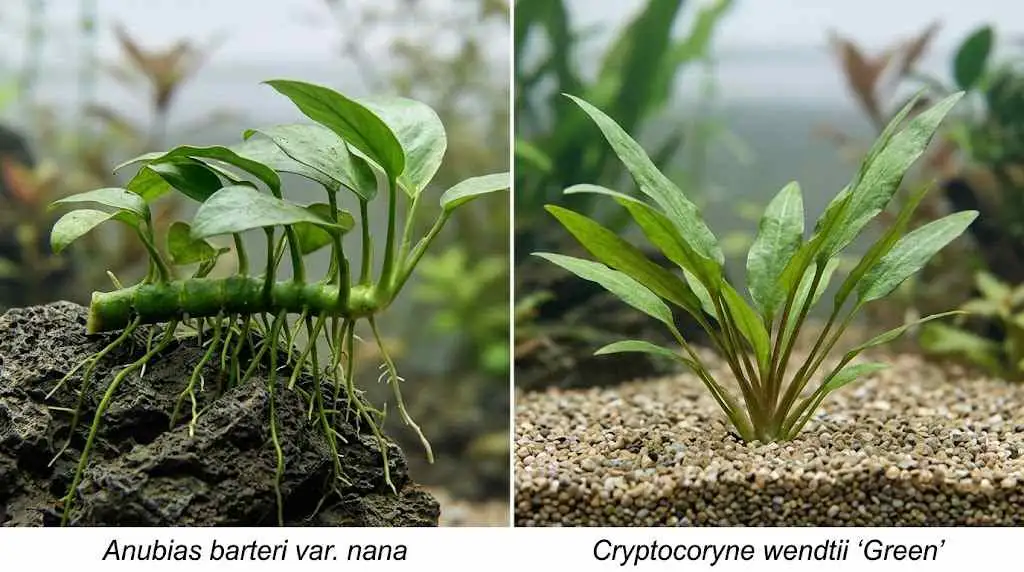
A rhizome is a thick, usually horizontal stem from which leaves and roots develop. It is not the same structure as the thin roots below it.
For Java fern and Anubias, keeping this stem above the substrate is essential. They can be secured to suitable hardscape while their roots establish. Roots may extend into the substrate; that does not mean the rhizome should be buried.
Java fern provides upright foliage. Standard forms are better suited to a space with some height than to a tightly packed foreground. Named forms differ, so check the actual plant rather than assuming every Java fern stays the same size.
Anubias nana offers a lower, broader-leaved alternative. Its slow growth can suit someone seeking low maintenance aquarium plants, provided they accept gradual filling-in and inspect older leaves for algae.
Neither needs a deep planting bed when attached to hardscape. Neither becomes nutrient-free simply because its roots are outside the substrate.
For placement and variety details, use the Java fern planting guide — Java Fern Care: Planting, Propagation and Common Problems] and choosing an appropriate Anubias — Anubias Care: Planting, Growth and Variety Selection].
Rooted rosettes: choose for the eventual footprint
A rosette produces leaves around a central growing point, or crown. Plant the roots securely while keeping that growing point at the substrate surface rather than deeply buried.
Cryptocoryne wendtii ‘Green’ is a useful option where you want a rooted group without constantly shortening stems. However, conditions influence its height and spread. Do not assume the small plant in a nursery cup will remain that size.
Choose its location before planting and allow space for neighboring leaves. Detailed establishment and leaf-loss questions belong in the Cryptocoryne guide — Cryptocoryne Care: Planting, Varieties and Melt].
Amazon sword ‘Bleherae’ presents a different decision. Tropica reports a height of approximately 20–50 cm, or 8–20 inches, and notes that its foliage can shade plants underneath. It is a conditional beginner choice for a roomy aquarium, not a default purchase for a nano tank.
Plan for its root system and nutrient supply as well as leaf height. See Amazon sword size and root requirements — Amazon Sword Care: Roots, Nutrients and Growth].
Stem plants: straightforward growth with regular pruning
Stem plants carry leaves along an elongated stem. They are useful when you want background structure and are comfortable trimming and renewing a group.
Ludwigia repens is a practical example for a reasonably illuminated area. Dennerle describes it as a variable, relatively fast-growing species that requires regular cutting back. Its listing supports medium-to-high light rather than treating it as interchangeable with a shade-tolerant Anubias.
Plant stems separately with room for light to reach their lower sections. As they extend, expect to shorten growth and sometimes replace tired lower stems with healthy tops.
An “easy red plant” label does not promise the same color or compactness shown in a promotional photograph. Ask which species or cultivar is being sold and under what conditions the pictured appearance developed.
For the detailed routine, see planting and pruning Ludwigia repens — Ludwigia Repens Care: Planting, Pruning and Color].
Mosses: small leaves, useful texture and hidden maintenance
Java moss can soften wood or rock and provide fine-textured habitat without a conventional planting bed. Begin with manageable patches that you can reach during maintenance.
Its practical workload is easy to underestimate. Fine growth can catch debris, and an expanding patch may conceal areas you need to inspect. Trim where necessary and remove loose clippings instead of allowing them to circulate throughout the tank.
Christmas moss, Vesicularia montagnei, offers a more regularly branching appearance. Tropica describes it as more demanding than ordinary Java moss and notes that pruning is needed to maintain its shape. It is an option for someone interested in shaping the growth, rather than an automatic upgrade in ease.
Compare Java moss attachment and maintenance — Java Moss Care: Attachment, Trimming and Shrimp Habitats] with Christmas moss shaping and care — Christmas Moss Care: Attachment, Growth and Trimming].
Floating plants: no planting bed, but a surface-management job
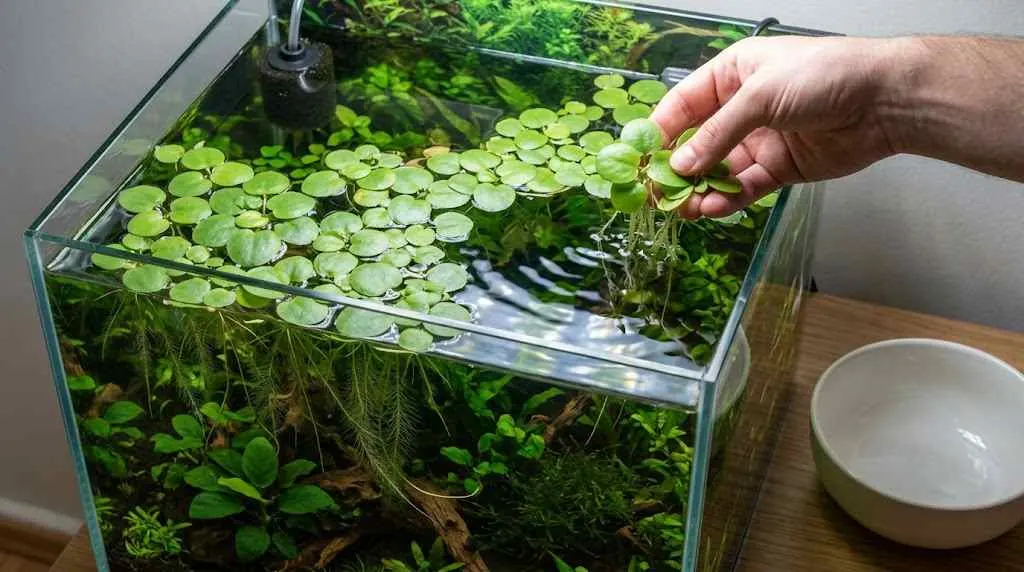
Floating plants avoid substrate planting, but they still occupy valuable space.
Amazon frogbit develops hanging roots and can create substantial shade. Choose it when you want that effect and can regularly thin the surface. Check that the roots will not obstruct access, feeding areas or equipment.
Inspect the actual surface environment before buying. Will an outlet repeatedly push plants underwater? Is there sufficient clearance beneath the cover? Does splashing keep the upper foliage wet? An open-tank display photograph does not establish suitability beneath your lid.
Duckweed is a different management choice. Common duckweed, Lemna minor, consists of tiny floating fronds and can multiply rapidly in favorable conditions. Its small size makes selective removal and checking for remaining fragments more fiddly than handling larger floaters. The RHS documents its rapid spread and shading effects; those characteristics warrant deliberate management in an aquarium too.
Choose duckweed because you want to manage it, not because rapid multiplication sounds maintenance-free.
Before obtaining floating species, check local restrictions and disposal guidance. Never release unwanted aquarium plants into natural waters.
For the broader comparison, see choosing and managing surface cover — Floating Aquarium Plants: Choosing and Managing Surface Cover].
Carpeting plants: a conditional beginner choice
A carpet creates a low layer across the substrate. That position matters: it may receive much less light than the upper leaves of taller plants.
Monte Carlo is often presented as an easy carpet, but the desired result needs defining. Tropica distinguishes survival under less favorable conditions from compact growth supported by stronger growing conditions, including CO₂ supplementation.
Before choosing it, establish:
- Whether sufficient light reaches the foreground.
- How small portions will remain anchored.
- How nutrients will be supplied.
- Whether you intend to inject CO₂.
- Whether you are willing to trim and collect clippings.
A thick carpet can also require maintenance beneath its visible surface. Do not select one solely to hide substrate cleaning.
If you want a basic aquarium with limited intervention, an open foreground may be the better starting decision. Use the carpet-plant comparison — Aquarium Carpet Plants: Options for Different Setups] before committing to a lawn.
Light, nutrients and CO₂ should match the selection
Many beginner aquatic plants can grow without injected CO₂. That does not mean carbon availability is irrelevant, or that every species will achieve the same speed, density or color without supplementation.
Likewise, fish waste and source water may supply some nutrients, but they do not guarantee a complete supply for every planted aquarium. The UK Aquatic Plant Society emphasizes matching plant demands to light, carbon and available nutrition.
Consider where nutrients will be available. Rooted plants can use an appropriate nutrient supply around their roots; attached plants, mosses and floaters need access through the surrounding water. These are practical placement considerations, not a rule that every species feeds exclusively through either roots or leaves.
Follow any fertilizer’s instructions and review plant response. Do not increase fish feeding to fertilize plants or raise lighting repeatedly while leaving other limitations unresolved.
Choose a manageable first combination
These are hypothetical selections, not fixed plant counts or guarantees.
Existing aquarium with wood and modest lighting
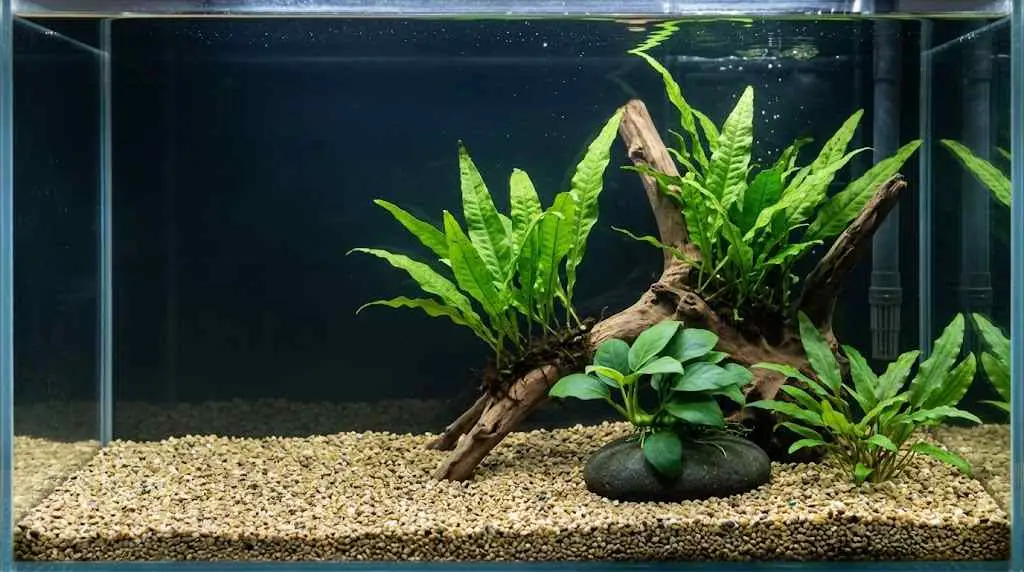
Choose a suitable Java fern form for height and Anubias nana for lower foliage. This avoids rebuilding the substrate. Allow space between plants and accept that the arrangement will fill in gradually.
Rooted display with room for substantial growth
Use Cryptocoryne wendtii ‘Green’ as a rooted group and consider a ‘Bleherae’ sword only if its eventual footprint fits. Add Ludwigia repens in a better-lit area if regular stem trimming appeals to you.
Shrimp aquarium focused on accessible habitat
Combine a small, reachable Java moss patch with attached leafy plants, leaving some open feeding and observation space. Fine growth provides habitat, but it should not become an inaccessible mass.
See choosing cover and grazing surfaces for shrimp — Plants for Shrimp Tanks: Choosing Cover and Grazing Surfaces].
Aquarium with limited routine trimming
Favor slower-growing attached plants and a manageable rosette group. Omit a carpet and fast-spreading surface cover unless you specifically want their upkeep. Low maintenance still includes inspecting plants and removing deteriorating material.
Buying and preparing live aquarium plants
Before buying, confirm the name, expected size, planting method and suitability for permanent submersion. A plant displayed beside aquarium supplies may instead be intended for a terrarium or for roots-only placement with foliage above water.
Packaging also affects preparation:
- Potted plants: Check the crown or rhizome and follow guidance for removing the pot and growing material.
- Bunched stems: Check that stems are sound and suitable for planting; remove transport restraints as directed.
- Attached plants: Inspect both the plant and its support, and confirm that the attachment leaves growing structures unobstructed.
- Tissue-culture cups: Check the seal and plant condition. Follow the producer’s directions for removing the growing medium and dividing the plants.
Tissue culture starts under controlled laboratory conditions, but that is not a blanket guarantee about every cup after handling or opening. Small plantlets still need appropriate establishment conditions.
Ask about prior treatments, especially for plants entering an aquarium with sensitive invertebrates. Inspection and rinsing cannot establish the absence of every hitchhiker or residue.
Use the plant quarantine and preparation guide — How to Quarantine Aquarium Plants Before Adding Them]. Avoid assuming one chemical dip is appropriate for every species and aquarium.
What to expect after planting
Some aquarium plants are nursery-grown emersed, with foliage above water, before being sold for submerged growth. Suitable amphibious species can produce different leaves underwater; new growth may therefore differ from the plant you purchased.
That possibility does not make every deteriorating plant a harmless case of “melt.”
Inspect the growing point, attachment or planting depth, new leaves and extent of deterioration. Remove decaying material appropriately. Check light reaching the plant, nutrient planning, water conditions and physical disturbance before changing several things at once.
Photographs taken from a consistent angle can help distinguish gradual establishment from continuing decline.
Closing selection checklist
Before choosing your first easy live aquarium plants, confirm:
- The identity and suitability for the intended submerged or floating position.
- The space needed beyond the nursery size.
- A planting method appropriate to the growth form.
- Light reaching the actual location.
- A realistic nutrient and CO₂ plan.
- Compatibility with livestock, flow and surface conditions.
- A maintenance task you are willing to repeat.
- A preparation and observation plan.
Avoid buying solely by color, treating every small pot as a permanently small plant or assuming fast growth means less work. “Hardy aquarium plants” are plants whose requirements fit your conditions—not plants that can overcome any mistake.
Start with a manageable selection, give each plant an appropriate position, and use its detailed care guide before adding more demanding choices.