
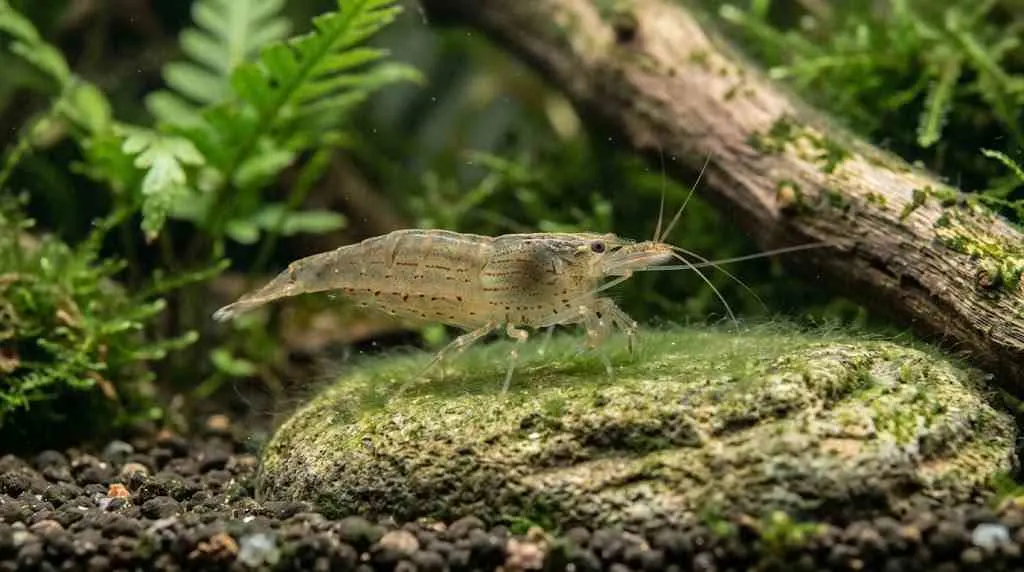
Amano Shrimp Care: Feeding, Tank Size and Compatibility
Amano shrimp thrive in mature freshwater aquariums with stable water, good oxygenation, shelter and reliable access to food. They are useful algae grazers, but they still need a feeding plan and protection from fish that might swallow, injure or repeatedly disturb them.
For a beginner, the strongest starting point is an established planted aquarium with room for a small group. Check your water and existing livestock before buying: an aquarium can look lush and clean while offering unsuitable conditions or too little accessible food.
Table of Contents
Amano shrimp care at a glance
The water values below are practical starting conditions within published husbandry ranges, not experimentally established optimums or survival limits.
| Care factor | Practical overview |
|---|---|
| Common names | Amano shrimp, Yamato shrimp, Japonica shrimp |
| Accepted scientific name | Caridina multidentata; Caridina japonica is an older synonym |
| Adult size | Approximately 4–5 cm, with females generally larger |
| Lifespan | Plan for several years; unusually long lives are reported |
| Tank planning | A planted 54-liter aquarium, approximately 14.3 US gallons, is a useful starting point for a small group |
| Group planning | Five shrimp is a practical starting group when space and food allow |
| Routine temperature | Around 20–25°C / 68–77°F |
| Water chemistry | A workable starting zone is pH 6.5–7.5 and GH 6–12°dGH; check KH and stability |
| Nitrogen waste | Ammonia and nitrite undetectable; prevent nitrate from steadily accumulating |
| Feeding | Surface grazing supported by suitable sinking food |
| Compatibility | Assess each tankmate’s size, behavior and feeding competition |
| Reproduction | Adults live in freshwater; larvae require saline conditions to develop successfully |
Identification: is it really an Amano shrimp?
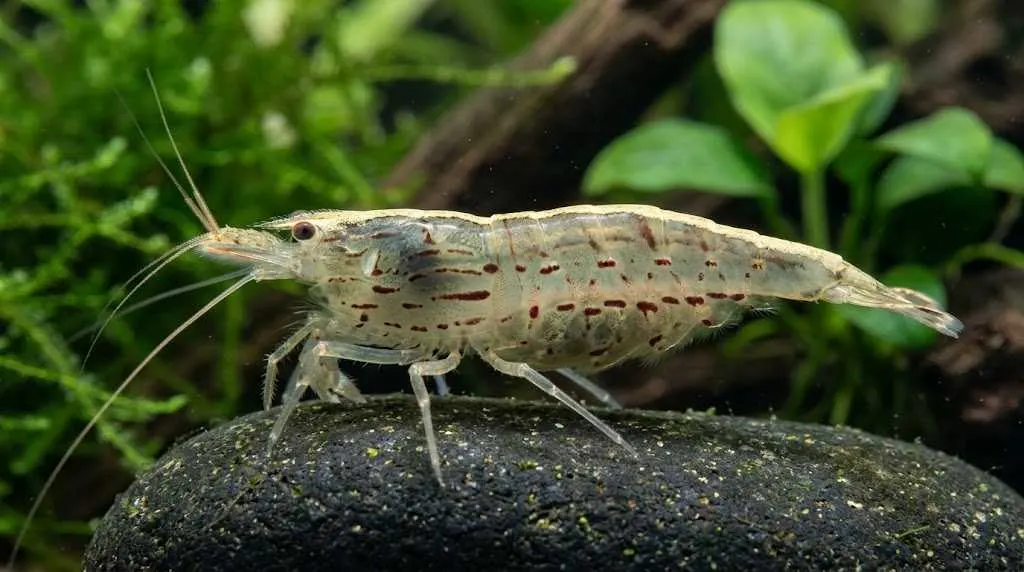
The accepted scientific name is Caridina multidentata. Older books and shop listings often use Caridina japonica for Amano shrimp. These names refer to the same species; C. japonica is listed as a synonym.
Typical Amano shrimp have a translucent body with a grey, tan or slightly bluish tint. Rows of brownish dots and short dashes run along their sides, and a lighter stripe may follow the back.
Mature females are usually larger and deeper-bodied. Their flank markings commonly include longer dashes, while males tend to show smaller dots. These are useful clues, particularly when comparing mature animals together.
One spot pattern cannot guarantee identification. Young shrimp, viewing angle and other similar-looking species can make identification difficult. Ask for the scientific name and clear photographs of mature stock if the label is vague. A transparent shrimp sold simply as an “algae shrimp” deserves further checking.
If you are still choosing a species, compare the options in the freshwater aquarium shrimp selection guide [INTERNAL LINK NEEDED: SH01 — Freshwater Aquarium Shrimp: A Guide to Choosing Your First Species].
Adult size and lifespan
Typical adult Amano shrimp size is approximately 4–5 cm, although males often remain smaller than large females. Plan around adult animals rather than the juveniles in a shop. Their eventual size affects access to crevices, feeding competition and which fish might regard them as prey.
Amano shrimp lifespan is less firmly documented than many care sheets suggest. Plan for a commitment lasting several years. Specialist keeper Chris Lukhaup reports lifespans of eight years or more, but that should be treated as a report of possible longevity, not an average or promise.
An animal’s age at purchase may also be unknown. Good nutrition, suitable water and protection from injury support long-term care, but no maintenance routine guarantees a particular lifespan.
Tank size: plan for usable habitat
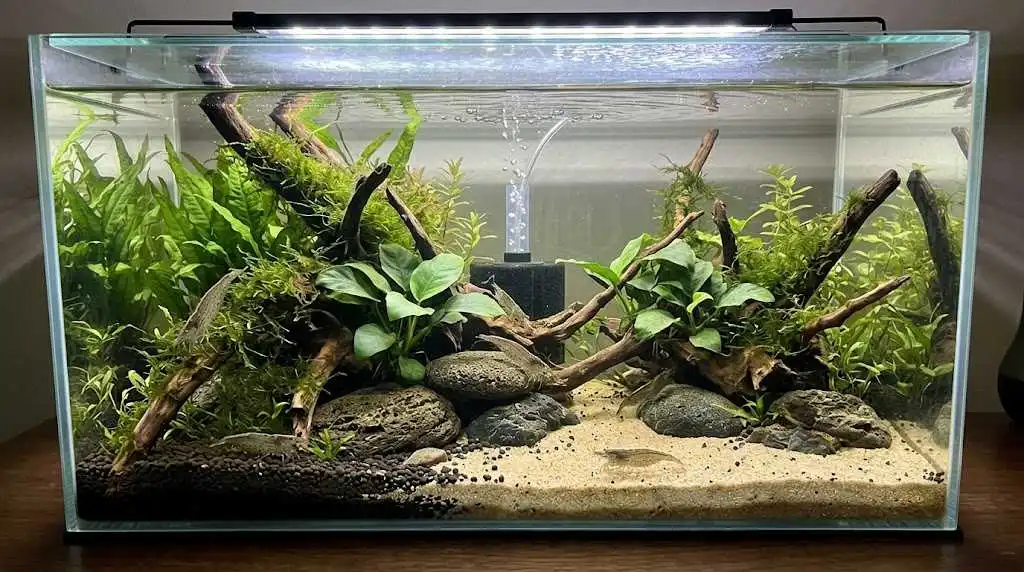
For a first group, a 54-liter aquarium—about 14.3 US gallons—with five Amano shrimp provides a useful planning baseline. Dennerle recommends groups of five or more from this volume. This is husbandry guidance, not a scientifically established minimum.
That starting point assumes established filtration, usable grazing surfaces, appropriate feeding and no unsuitable fish. Adding a group to a crowded community aquarium is a different decision from stocking a dedicated shrimp tank.
More water offers useful room for error, but volume alone is insufficient. A tall, sparsely furnished aquarium may offer less accessible habitat than a well-arranged tank with a broader footprint.
Provide:
- Plants, moss and driftwood for grazing and cover.
- Several retreats large enough for adult shrimp.
- Open routes between shelter and feeding areas.
- Access for siphoning waste without dismantling the habitat.
A mature aquarium offers established surface growth as well as functioning biological filtration. Clear water and a recently installed filter do not demonstrate readiness.
Use a sponge filter or suitable intake protection, and keep the filter running continuously. Maintain surface movement while leaving calmer areas where shrimp can rest.
Fit a secure lid and close gaps around tubing and cables without compromising ventilation. Amano shrimp can climb out; a healthy-looking aquarium still needs escape prevention.
Temperature and water conditions
A practical Amano shrimp temperature range for routine care is 20–25°C / 68–77°F. Published care ranges extend beyond this, but the upper and lower endpoints should not become targets simply because the species may tolerate them.
Use a thermometer to check actual conditions. A heater is useful when needed to maintain an appropriate temperature; a warm room may require attention to overheating instead.
Warmer water holds less dissolved oxygen. Preserve surface agitation during warm weather and avoid allowing uneaten food or decaying material to accumulate.
Understand hardness before adjusting it
Amano shrimp can adapt to a range of moderately mineralized freshwater conditions. A starting zone around pH 6.5–7.5 and GH 6–12°dGH sits within published care ranges, but suitable, stable water outside that narrower zone does not automatically need changing.
General hardness, or GH, reflects dissolved calcium and magnesium. Carbonate hardness, or KH, helps indicate the water’s buffering capacity. Test both your aquarium and replacement water so you understand what happens during water changes.
Do not repeatedly add chemicals to force a single pH number. Equally, stability does not make unsuitable water acceptable. If your source water requires modification, establish a repeatable preparation method before buying shrimp. Pure reverse-osmosis water should not be used as their complete habitat water without appropriate remineralization.
Monitor waste and introduce shrimp carefully
Ammonia and nitrite should remain undetectable on suitable aquarium tests. Monitor nitrate as a trend, including its level in your source water, and adjust maintenance before it continually rises.
Prepare an arrival plan with the supplier. For locally collected shrimp in good transport water, gradual adjustment to temperature and chemistry helps avoid abrupt changes.
Long shipping journeys need extra consideration: ammonia can accumulate in transport water, and its toxicity changes with pH and temperature. Do not assume a prolonged drip is always beneficial; follow shipping-specific instructions and avoid leaving shrimp unnecessarily in deteriorating water.
Feeding: make sure the shrimp actually receive food
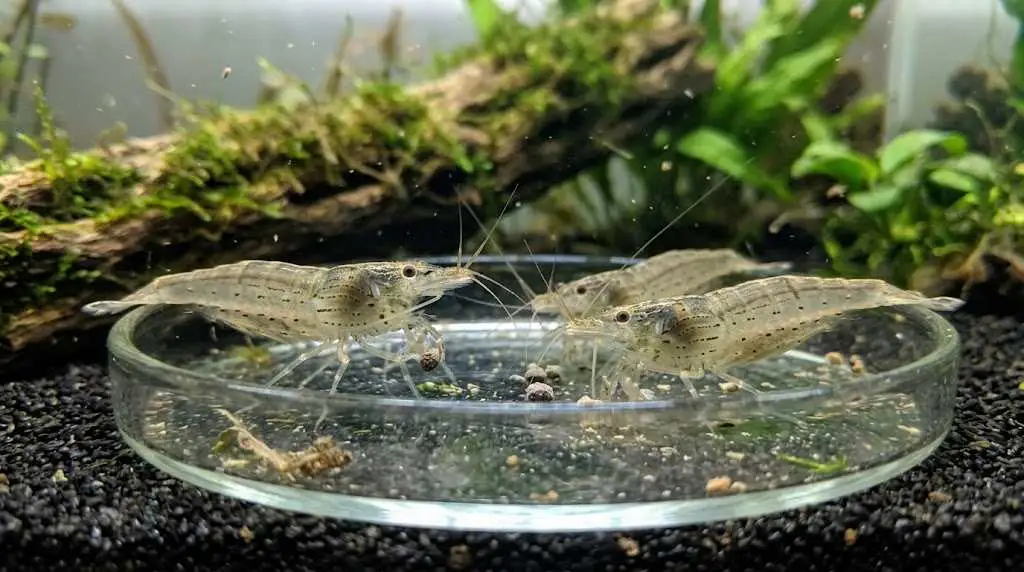
Amano shrimp graze over leaves, wood, stones and substrate, picking at algae, biofilm and other edible material. Their activity does not prove that the aquarium supplies a complete diet.
Use a suitable complete sinking shrimp food as the foundation of supplementary feeding. Small sinking granules or broken pieces of appropriate food can make distribution easier. Occasional small portions of softened vegetables can add variety, but should not displace balanced food.
Begin with a modest amount and observe:
- Can every shrimp reach some food?
- Does one animal carry away the entire portion?
- Do fish intercept it before it reaches the shrimp?
- Is uneaten food remaining or disappearing into inaccessible places?
Divide food among several locations when competition prevents access. Inspect hidden feeding spots as well as the visible dish.
Frequency depends on the shrimp’s size, number, natural grazing supply and other feeding in the aquarium. Check access daily and adjust portions to what you observe rather than following a fixed pellet-per-shrimp rule.
Hypothetical example: Five Amano shrimp in a heavily planted aquarium may need less supplementary food than five in a sparsely furnished tank. In either aquarium, fish might consume every sinking pellet first. Watching who gets the food matters more than counting what was added.
What their algae grazing can—and cannot—do
Amano shrimp can make a useful contribution to algae management. In Tropica’s trials, they consumed biofilm containing green algae and diatoms grown on ceramic tiles. Those results demonstrate grazing ability under the test conditions, not guaranteed removal of every aquarium algae problem.
Do not deliberately underfeed shrimp to make them “work harder.” They cannot compensate indefinitely for excessive lighting, accumulated waste or poor plant growth.
For differences between grazers and algae types, read which aquarium shrimp eat which algae [INTERNAL LINK NEEDED: SH19 — Do Aquarium Shrimp Eat Algae? Species and Algae Compared].
If growth is covering plant leaves, combine husbandry adjustments with appropriate algae removal from live plants [INTERNAL LINK NEEDED: AP28 — How to Remove Algae from Live Aquarium Plants].
Behavior, hiding and molting
Expect grazing, climbing, short swims and occasional rushes toward food. An Amano shrimp carrying a pellet into cover is not necessarily frightened or starving.
Shrimp molt as they grow and renew their exoskeleton. The discarded shell can resemble a complete shrimp, but it is hollow and translucent. After molting, the animal may remain concealed while its new covering hardens.
Avoid pulling apart shelters to find a recently molted shrimp. An ordinary clean molt can usually remain available for grazing; a dead animal should be removed.
Repeated failed molts call for investigation of water changes, mineral balance, diet and other stressors. Do not diagnose a calcium deficiency from one unsuccessful molt or add supplements without checking the water.
When unusual behavior needs investigation
One shrimp exploring near the surface does not establish an emergency. Several shrimp suddenly gathering high in the aquarium, repeatedly trying to escape or losing their usual activity warrant prompt checks.
Check temperature, ammonia, nitrite, filter operation and surface movement. Review recent water changes, dosing, new decorations and tankmate behavior. Increase aeration if oxygen shortage is suspected, and address any measured water-quality problem with appropriately prepared replacement water.
A lid prevents escape, but it does not resolve whatever may have prompted the behavior.
Tankmates: assess risk beyond a compatibility list
Adult Amano shrimp are larger than many dwarf shrimp, which can reduce predation risk from some small fish. Size does not protect them from every attacker, especially immediately after molting.
Small community fish may be suitable candidates, but assess the actual species and individuals. Large predatory fish, fish that persistently hunt crustaceans, and animals that repeatedly nip or chase shrimp are poor choices.
Before combining livestock, ask:
- Can the fish swallow the shrimp or damage its legs and antennae?
- Does it investigate crevices where molting shrimp hide?
- Can shrimp reach food without repeated harassment?
- Do their temperature and water requirements overlap?
A fish sold as peaceful may still eat a small shrimp. Young Amanos may also face greater risks than the adults pictured in a care guide.
Other shrimp and snails can be possible companions when conditions match. However, Amanos can dominate feeding, so ensure smaller or slower animals receive food too. Lukhaup highlights this competition in his freshwater shrimp husbandry account.
Use the tankmate predation-risk guide [INTERNAL LINK NEEDED: SH26 — Shrimp Tank Mates: How to Assess Predation Risk] before adding unfamiliar companions.
Medications, fertilizers and copper
Check the exact product, dose and manufacturer’s instructions before treating an aquarium containing shrimp. “Safe for fish” does not establish invertebrate safety.
Copper requires context. It is a trace nutrient, while higher exposures can be harmful. The presence of copper in an ingredient list alone does not determine whether a correctly dosed fertilizer is unsuitable.
For example, Seachem identifies its trace-containing Flourish fertilizer as suitable for shrimp, while its copper medication Cupramine requires removal of invertebrates before treatment. These statements apply to those formulations and directions, not every product in either category.
Avoid combining or increasing doses casually. When treatment is necessary, confirm a plan that accounts for every aquarium inhabitant.
Breeding: eggs do not mean a growing freshwater colony
Female Amano shrimp can carry eggs and release larvae in freshwater. The newly hatched larvae are free-swimming and need saline conditions for successful development into juveniles.
Research has demonstrated development in saline rearing treatments, supporting this distinction between adult habitat and larval requirements.
You do not need to add salt to the adult display aquarium because a female carries eggs. Raising the young is a separate project involving water preparation and specialized feeding.
Continue to the Amano breeding and salinity guide [INTERNAL LINK NEEDED: SH21 — Breeding Amano Shrimp: Eggs, Larvae and the Salinity Challenge] for that process.
A manageable care routine
Daily: Check temperature, filter operation, shrimp activity and food access. Remove obvious uneaten food and investigate sudden changes in behavior.
Weekly: Test water and record the results. As an initial routine, consider changing roughly 20–25% with dechlorinated replacement water of closely matched temperature and chemistry, then adjust to stocking and measured waste accumulation. OATA emphasizes that the necessary frequency and volume vary between aquariums.
As needed: Clear intake sponges when flow falls, remove trapped waste and trim plants while retaining shelter. Check discarded plant trimmings and siphoned water for shrimp.
Common mistakes include introducing shrimp into an immature aquarium, relying entirely on algae, overlooking feeding competition and repeatedly changing chemistry without a measured reason. Another is buying more shrimp to solve algae growth before determining whether the aquarium can support them.
Is your aquarium ready?
Amano shrimp are a good fit when your aquarium offers stable freshwater conditions, reliable filtration, accessible food and protection during molting. Before buying, record your water results, review each tankmate and decide where the shrimp will feed and shelter.
For an existing group, the most useful next step is often observation: confirm that every animal can eat, retreat and graze without persistent disturbance.