Bamboo Shrimp Care: Flow, Filter Feeding and Tank Setup
Bamboo shrimp need secure feeding positions where moving water delivers fine, edible particles to their fans. A suitable aquarium also provides established biological filtration, oxygenated water and sheltered places to rest and molt.
A powerful filter alone cannot meet those needs. Its outlet might send water above the shrimp, leave food trapped behind plants or remove particles before they reach the feeding perch. Successful bamboo shrimp care means checking the relationship between the animal’s position, the current and its food supply.
Table of Contents
Bamboo shrimp care at a glance
| Care factor | Practical guidance |
|---|---|
| Scientific name | Atyopsis moluccensis |
| Common names | Bamboo shrimp, wood shrimp, Singapore flower shrimp; sometimes simply “fan shrimp” |
| Adult size | Often around 5–8 cm; allow room for larger individuals approaching 10 cm |
| Lifespan | Aquarium guides commonly quote approximately 2–3 years, but a reliable typical captive lifespan is not established |
| Feeding method | Captures suspended particles with four fan-shaped feeding appendages |
| Routine temperature | Approximately 23–26°C (73–79°F), a practical working band within published husbandry ranges |
| Water conditions | Stable freshwater; pH around 6.5–7.5 and moderate mineral content provide a useful starting point |
| Tank planning | Around 75 liters (20 US gallons) or more offers useful room for feeding sites, shelter and maintenance |
| Flow | A steady current through an accessible feeding position, with calmer retreats nearby |
| Compatibility | Avoid predators and animals that repeatedly disturb the shrimp or nip its fans |
These recommendations concern adult A. moluccensis. Tank volume and equipment specifications cannot confirm that an individual is obtaining enough food.
Identification, size and lifespan
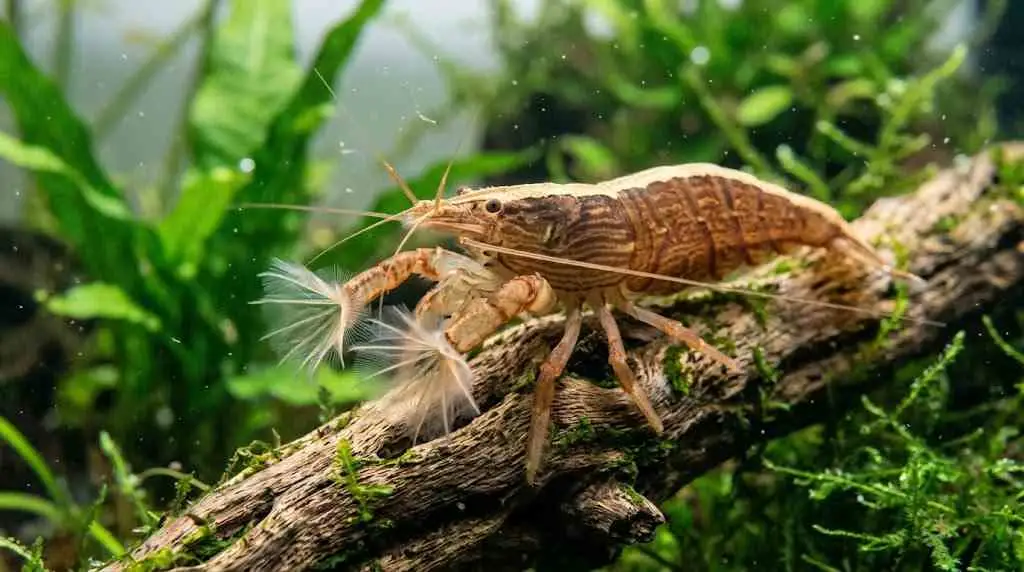
The accepted scientific name is Atyopsis moluccensis, a shrimp in the family Atyidae. Its first two pairs of feeding legs carry brushes of fine bristles that open into the characteristic fans.
Bamboo shrimp have a substantial body compared with dwarf aquarium shrimp. Brown, tan and reddish tones are common, often accompanied by longitudinal markings and a lighter dorsal stripe. Color varies, so it should not independently determine species, sex or health.
Size reports differ between husbandry sources. Many aquarium specimens fall around 5–8 cm, while larger individuals are reported near 10 cm. Plan the perch and shelter around an adult animal rather than its size at purchase.
“Fan shrimp” describes a feeding adaptation shared by several shrimp. It is not a unique species name. The African vampire shrimp, Atya gabonensis, is another familiar example; its detailed care belongs in the African fan shrimp guide — Vampire Shrimp Care: Feeding and Habitat for African Fan Shrimp].
How long do bamboo shrimp live?
A bamboo shrimp lifespan of approximately two to three years is frequently quoted in aquarium guidance. However, much longer estimates also appear, and these sources do not establish a robust population average. Treat the shorter figure as a rough husbandry estimate rather than a biological deadline.
Age at purchase is often unknown. An adult’s remaining lifespan therefore cannot be predicted from its arrival date, and an early death should not automatically be attributed to old age.
Tank size and habitat arrangement
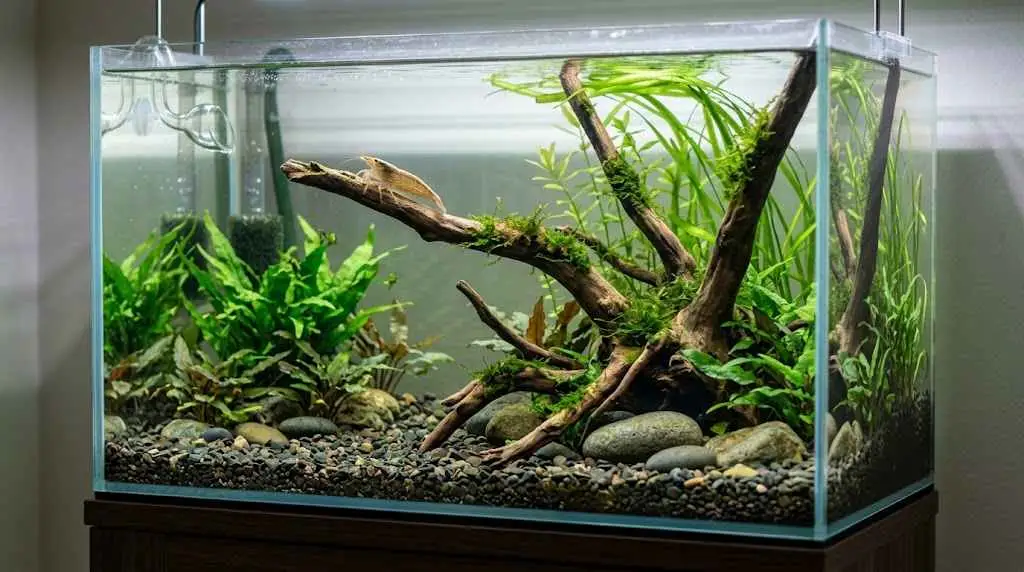
Choose room for a functioning feeding area
For a first setup, around 75 liters (20 US gallons) or more is a practical planning recommendation. The Shrimp Farm recommends approximately this volume for a group. It provides space to arrange exposed feeding positions alongside sheltered retreats, but it is not an experimentally established minimum.
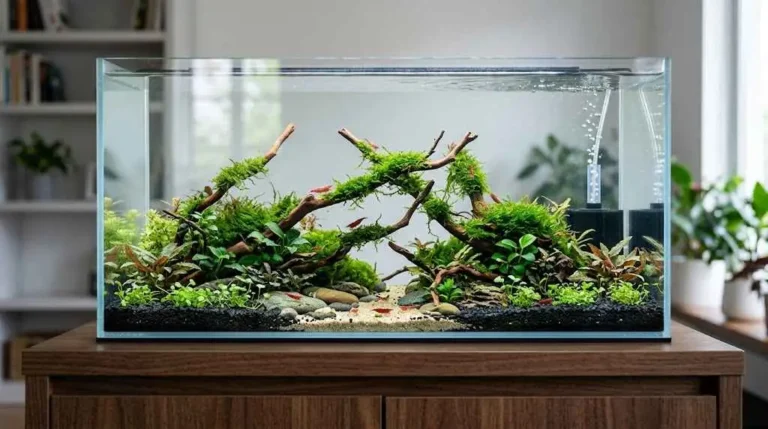
Bamboo shrimp tank size should account for usable layout, the number of animals and the food that the aquarium can receive without deteriorating water quality. A tall aquarium filled with dense plants may offer fewer useful feeding positions than a longer aquarium of similar volume.
Groups can be maintained, but there is no reason to add animals merely to meet an unsupported universal group-size rule. Each additional shrimp needs reliable feeding access. Several animals sharing one perch can be interesting to watch, but their presence does not demonstrate equal food intake.
Establish the aquarium before stocking
Complete the nitrogen cycle and confirm that biological filtration can process the expected waste load. Undetectable ammonia and nitrite in an empty aquarium do not prove this capacity.
Maturity also allows microbial communities to develop on plants and other surfaces. Nevertheless, an established aquarium does not necessarily release enough suitable particles into the water to sustain a fan feeder. Plan supplemental feeding from the beginning rather than waiting for obvious decline.
Arrange perches, shelter and access
Use stable wood or rocks to create feeding positions at different heights. Secure them so they cannot roll or shift beneath the shrimp.
Provide shaded retreats behind or beneath the hardscape. Plants can offer cover, but leave a clear route for moving water to reach the fans. Keep at least one feeding position visible and accessible with a pipette.
Protect filter and circulation-pump intakes. A device that produces useful current can still present a hazard at its suction side. Inspect guards after maintenance and remove accumulated debris before it restricts flow.
Understanding bamboo shrimp flow requirements
Field observations in Borneo found A. moluccensis associated with relatively fast water and boulder substrates. This supports providing flowing feeding areas and substantial footholds, rather than treating the whole aquarium as one uniform current.
The conditions at the perch matter more than an advertised pump rating. Rocks, plants, outlet direction and clogged equipment all affect where water actually travels.
A useful feeding position lets the shrimp maintain secure footing while extending its fans into passing water. It should also have a route into calmer cover. Repeated slipping, tumbling or retreat from a direct jet warrants checking the arrangement; stronger flow is not automatically better.
Assess the current where feeding happens
During a normal feeding, release a small amount of prepared food upstream and watch its route:
- Does it pass through the space occupied by the open fans?
- Does it travel above or behind the shrimp?
- Does it settle before arriving?
- Does it disappear into a filter intake first?
Adjust outlet direction or perch placement before increasing pump power. Make one change at a time so its effect remains clear.
Hypothetical example: Two branches sit beneath the same outlet. One lies behind a dense plant, where particles settle. The other projects into moving water. Repositioning the obstructed branch may improve food delivery without changing the pump.
A circulation pump may help when existing equipment cannot create a usable feeding area. It moves water; it does not necessarily provide biological filtration. For equipment choices, see how aquarium filtration systems compare — Aquarium Filters Compared: Choosing a Filtration System].
Good oxygenation and food availability also require separate checks. Water can be well oxygenated while carrying very little edible material.
Bamboo shrimp food and delivery
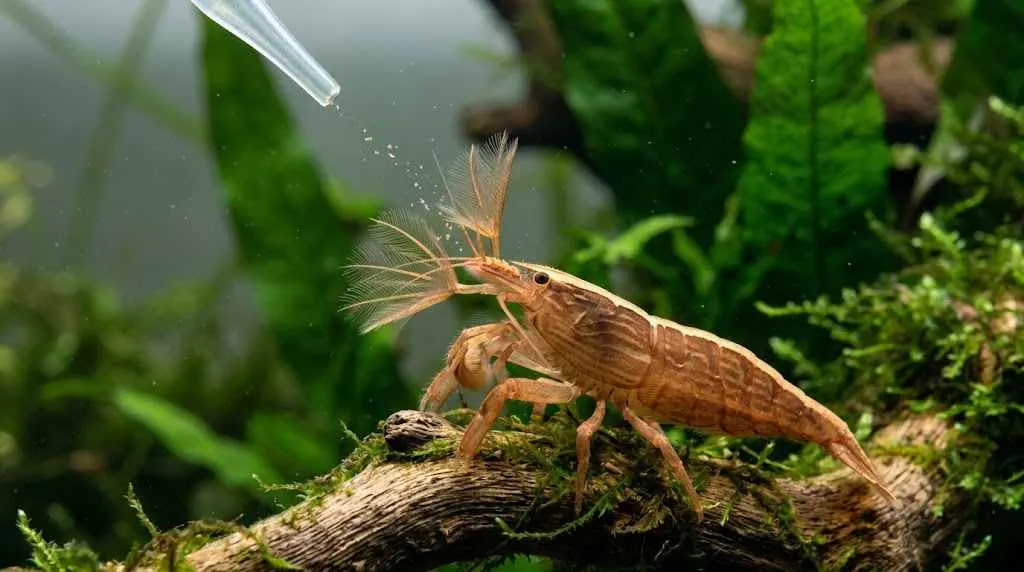
Bamboo shrimp collect fine suspended material and repeatedly bring their fans toward their mouthparts. Their feeding method requires appropriate food to arrive in a form they can capture.
A purpose-made powdered food for freshwater fan shrimp is a useful starting option. Suitable formulations combine nutritional ingredients rather than relying entirely on algae. Finely powdered aquarium foods and appropriately small live or frozen foods can provide variety, but a whole sinking pellet is not automatically accessible in the same way.
Particle size matters, but there is no need to invent a universal micron target. Check whether the selected food disperses, reaches the fans and is handled by the shrimp.
Use an observation-based feeding routine
- Prepare a small portion. Mix the food with aquarium water in a clean container. Use the product’s directions as a starting reference, adjusted to your aquarium.
- Deliver it upstream. Gently release the suspension where the current will carry it through the feeding position. Avoid blasting the animal.
- Watch the response. Look for particles contacting the fans and repeated fan-to-mouth movements. Open fans alone show an attempt to feed, not adequate intake.
- Check where the remainder goes. Look for deposits on the substrate or behind decorations. Persistent accumulation means some food is missing its intended recipient.
- Reassess the routine. Review delivery, portion and frequency when shrimp numbers, plant growth, equipment or feeding behavior changes.
Pre-mixing powdered food and delivering it with a pipette or into the current is also recommended by specialist feed manufacturers.
Preserve enough circulation to transport food during feeding. If filtration captures most of it first, try a different release point. Avoid routinely switching off all circulation when moving water is part of the feeding mechanism.
Several modest feeding opportunities may be more manageable than a large cloud of food, but the appropriate routine depends on the product, animals and aquarium. Record what you offer and what you observe. Do not increase the dose indefinitely because a shrimp remains in the current.
For broader nutrition and portion-setting principles, use the aquarium shrimp feeding guide — What to Feed Aquarium Shrimp and How Often], while retaining this species’ need for suspended delivery.
Interpreting feeding observations
A single movement rarely explains an animal’s condition. Look for changes from its usual behavior and observations repeated across feeding opportunities.
| Observation | Possible explanations | What to check next |
|---|---|---|
| Open fans at a familiar perch | Suitable positioning and an attempt to collect food | Whether food reaches the fans and is transferred toward the mouth |
| A different perch is used | Changed current, food distribution, disturbance or ordinary exploration | Outlet direction, plant growth, equipment flow and tankmate activity |
| Occasional substrate picking | Opportunistic collection or temporary exploration | Whether normal suspended feeding also occurs |
| Persistent picking with little observed fan feeding | Inadequate food delivery, unsuitable flow or impaired feeding structures | Food route, fan condition and response to a carefully delivered meal |
| Difficulty maintaining position | Excessive local force, poor footing, disturbance or weakness | Perch stability, current direction and water conditions |
| Reduced feeding with hiding | Molting, disturbance or a possible health or environmental problem | Recent changes, water tests and subsequent feeding opportunities |
Repeated substrate scraping deserves attention, but it does not prove starvation on its own. Equally, a shrimp sitting motionless in a strong current is not proof that its nutritional needs are met.
If feeding appears impaired, investigate delivery and conditions together. Adding food will not solve a perch that the food consistently bypasses.
Water conditions and maintenance
A practical routine temperature band is approximately 23–26°C (73–79°F). This sits within overlapping husbandry recommendations rather than defining the species’ complete tolerance limits.
A pH around 6.5–7.5, with moderately mineralized water, is a useful starting point. Published hardness recommendations vary; measure GH and KH and compare them with the supplier’s conditions instead of adding minerals automatically.
Maintain undetectable ammonia and nitrite, and keep nitrate low through appropriate feeding and maintenance. Treat replacement tap water for chlorine and chloramine, and avoid abrupt changes in temperature or chemistry.
Powdered food can spread into places where it is difficult to see or remove. Decomposition consumes oxygen, while warmer water holds less dissolved oxygen than cooler water. These relationships make excess food and hot conditions a combination worth watching closely.
Schedule regular partial water changes and adjust their volume to test results and accumulated waste. Remove concentrated debris, clear blocked intake guards and clean filter media appropriately without replacing all established biological material together.
Keep the aquarium clean. Deliberately allowing waste to accumulate is an unreliable way to supply nutrition and can undermine the water quality the shrimp needs.
Compatibility, shelter and molting
Bamboo shrimp are generally peaceful, but their feeding structures and settled feeding posture make disturbance an important compatibility issue.
A tankmate does not need to swallow the shrimp to cause trouble. Repeated investigation, pecking at fans or displacement from the feeding perch can interfere with food collection. Large predatory fish and clawed crustaceans are particularly poor candidates.
Assess the individual animals and the layout rather than relying on a universal safe-tankmate list. Other filter feeders may share food resources, while active fish may intercept supplemental food. Observe what reaches the shrimp after feeding the rest of the aquarium.
During molting, a shrimp may withdraw and feed less. Leave its shelter undisturbed and avoid moving it simply to check its condition. An empty exoskeleton is evidence of a molt, not a dead animal.
Persistent hiding alongside missed feeding opportunities, impaired movement or problems affecting other inhabitants warrants investigation. Neither hiding nor a suspected difficult molt independently establishes mineral deficiency.
Bamboo shrimp breeding: a separate challenge
Bamboo shrimp breeding involves a larval stage with requirements different from those of freshwater adults. Carrying eggs does not mean a normal freshwater aquarium will produce surviving juveniles.
Controlled experiments have successfully raised A. moluccensis larvae to the juvenile stage in saline water. They also found differences between A. moluccensis and A. spinipes, demonstrating why generic fan-shrimp breeding recipes can be misleading.
Successful research culture establishes that breeding is possible, but it does not make an improvised home protocol dependable. Larval food, water management and species identification require separate preparation.
Maintain the adult aquarium as freshwater. A larval salinity requirement is not a reason to add salt to the display tank.
Common mistakes and a practical checklist
The central mistakes are assuming maturity guarantees food, increasing current without observing the perch and treating substrate picking as a diagnosis. Excess powdered food, exposed intakes and a lack of retreats can compound those problems.
Before buying a bamboo shrimp—or reviewing an existing setup—check that:
- Biological filtration is established and water tests are satisfactory.
- Secure perches receive moving water across the likely fan position.
- Sheltered resting and molting places are available.
- Intakes are protected and accessible for cleaning.
- Suitable fine food can be delivered and its route observed.
- Feeding and water quality can be reviewed together.
- Tankmates allow the shrimp to feed without repeated disturbance.
If this routine does not suit your aquarium or maintenance preferences, compare alternatives in the freshwater shrimp selection guide — Freshwater Aquarium Shrimp: A Guide to Choosing Your First Species].
For an existing bamboo shrimp, begin with one observed feeding. Follow the food from its release point to the occupied perch, then check the animal’s handling of it and where leftovers settle. That observation can reveal whether the next useful change is a better feeding position, different delivery or closer attention to aquarium conditions.