Plants for Shrimp Tanks: Choosing Cover and Grazing Surfaces
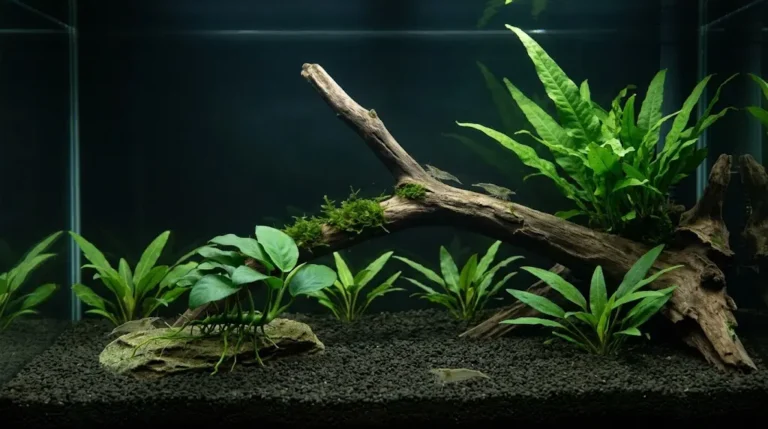
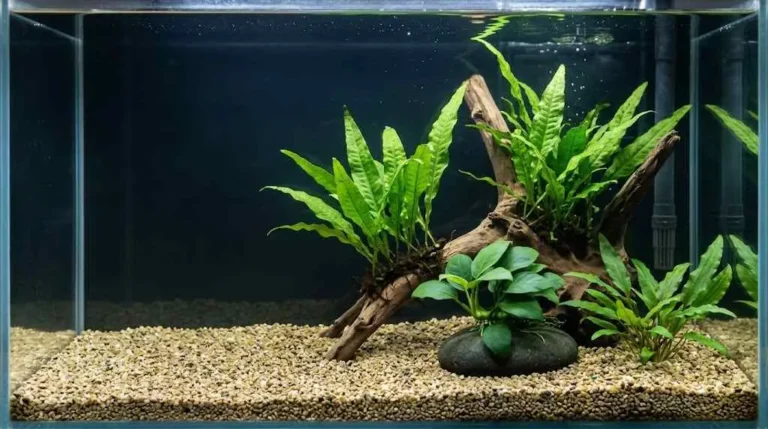
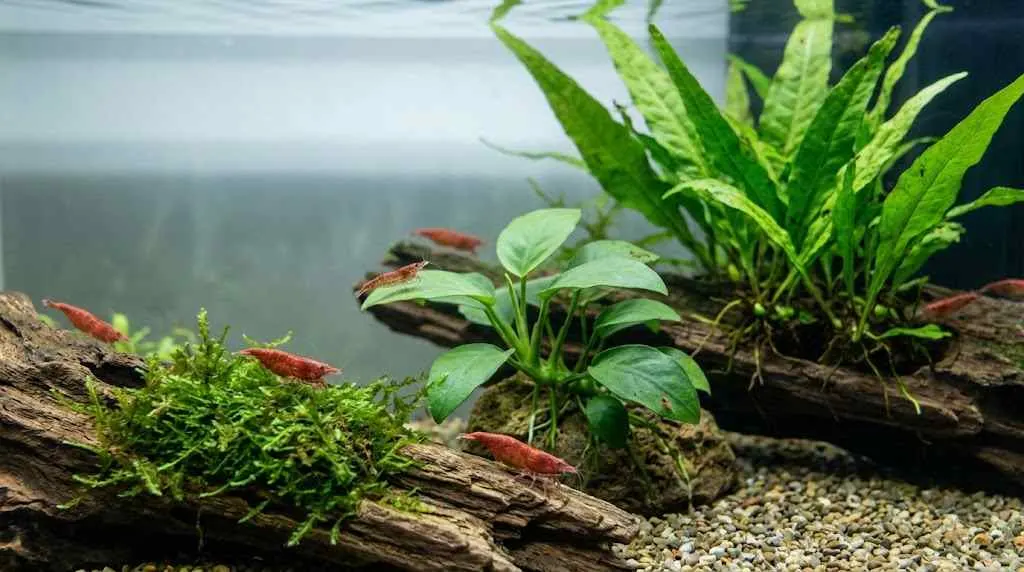
Choose plants for shrimp tank by the habitat they create and the conditions you can maintain. A manageable moss patch can provide fine shelter, attached leafy plants add accessible surfaces, and rooted or floating plants create structure at different heights.
A useful starting combination is one plant that provides small sheltered spaces and another that offers broader leaves or roots for grazing. Leave room to feed, observe the shrimp and maintain the aquarium.
The examples here primarily suit an established cherry shrimp aquarium containing Neocaridina davidi, provided each plant’s requirements match the actual water, light and layout. They are not a universal planting recipe for every freshwater shrimp. Source information and preparation matter just as much as the species name.
Table of Contents
Plants for Shrimp Tank: How They Support a Thriving Habitat
Plants create several distinct resources:
- Sheltered spaces: Leaves, branching growth and attachment points provide places to rest or retreat.
- Grazing surfaces: Established leaves and stems can support biofilms—surface-associated communities of microorganisms and organic material.
- Vertical structure: Plants make parts of the water column usable alongside the substrate and hardscape.
- Small-scale habitat: Fine branches and closely spaced leaves create openings that tiny juveniles can enter.
Cherry shrimp graze on biofilms and consume small organisms associated with submerged surfaces. However, a new plant is not automatically a well-stocked feeding area, and visible surface growth does not prove that the colony receives a complete diet.
Research also supports the value of shelter. In a controlled N. davidi study, shrimp used the tested moss shelter extensively. The experiment assessed shelter preference and activity, not survival alongside predatory fish. It therefore supports providing suitable structure without establishing that moss makes a community aquarium safe.
Plants also use nutrients as they grow, but they do not replace feeding, filtration, cycling or water-quality monitoring.
Check the aquarium before choosing plants
Before buying aquarium plants for shrimp, check:
- Shrimp identity and water conditions: Select plants that fit the inhabitants’ established temperature and chemistry.
- Available space: Consider mature height and spread, not the size of the sales pot.
- Light and shading: Check where light reaches, including beneath floating plants and overhanging wood.
- Planting opportunities: Identify suitable substrate areas and attachment points on hardscape.
- Water movement: Avoid positions where delicate growth is continually displaced or floaters are pushed underwater.
- Other inhabitants: Consider plant damage, food competition and access by potential predators.
- Maintenance access: Keep filter components, feeding areas and inspection routes reachable.
- Your preferred workload: Decide whether you can manage trimming, surface thinning or occasional replanting.
If aquarium readiness or equipment remains unresolved, start with preparing a freshwater shrimp aquarium — How to Set Up a Freshwater Shrimp Tank].
For a wider comparison beyond shrimp habitat, see choosing beginner aquarium plants — Aquarium Plants for Beginners: Choosing Your First Plants].
Plant comparison: habitat function and practical limitations
The following choices illustrate complementary functions. The habitat assessments concern physical structure; they are not measured rankings of juvenile survival or food production.
| Plant or defined variety | Growth form | Habitat function | Placement | Care and maintenance | Main limitation |
|---|---|---|---|---|---|
| Java moss, Taxiphyllum barbieri | Branching moss | Fine shelter and numerous small surfaces | Secure manageable patches to wood or stone | Relatively modest light demand; trim and remove trapped debris | Thick growth can obstruct inspection and cleaning |
| Anubias barteri var. nana | Rhizome plant | Broad grazing surfaces and sheltered edges | Attach to hardscape with rhizome uncovered | Slow growth; inspect older leaves and divide when crowded | Fills space slowly; leaves can accumulate algae |
| Java fern, Microsorum pteropus | Rhizome fern | Upright foliage and cover around attachment points | Attach to wood or rock | Suitable for modest lighting; remove deteriorating foliage selectively | Standard forms need more vertical space than a small sales plant suggests |
| Cryptocoryne wendtii ‘Green’ | Rooted rosette | Lower-level leaf cover and transitions between open and planted areas | Plant roots in substrate, keeping the crown at the surface | Provide rooting space and appropriate nutrition; manage spread | Establishment and eventual size vary with conditions |
| Ludwigia repens | Stem plant | Background structure and branching cover | Plant individual stems with room for growth | Needs a reasonably lit position and regular pruning | Repeated trimming and replanting can create disturbance |
| Amazon frogbit, Limnobium laevigatum | Surface-floating plant | Hanging-root structure and shade | Float in a suitable surface area | Thin coverage and inspect roots | Can shade lower plants and obstruct access |
Every option still requires source assessment and appropriate preparation before introduction.
Mosses for shrimp tanks
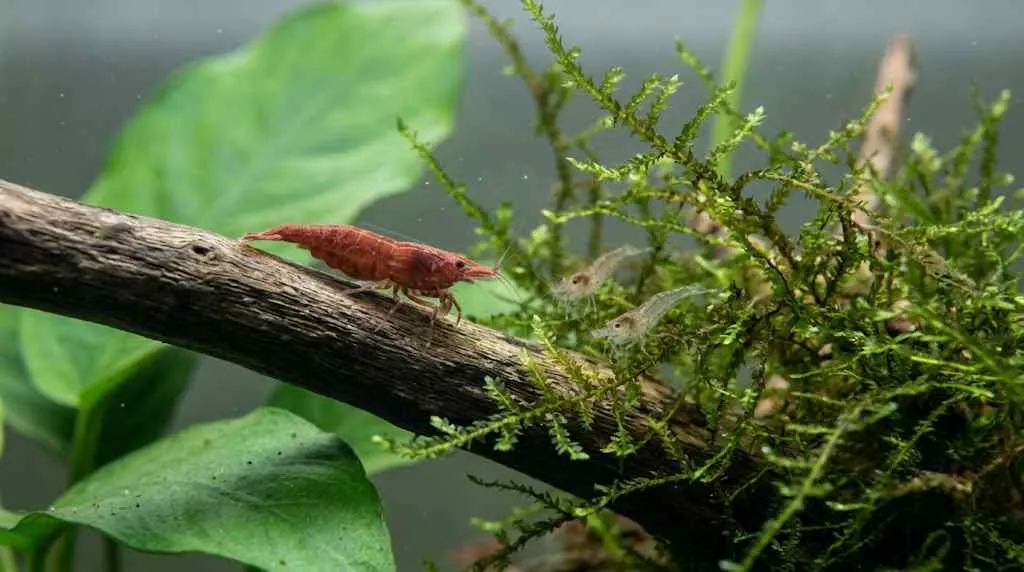
Shrimp tank moss is useful when its fine structure remains accessible without becoming an impenetrable mass.
Java moss is a practical starting choice for a modestly lit aquarium. Attach small portions where you can inspect them, rather than packing moss tightly behind equipment. Avoid loose fastening loops that could catch animals, and check attachments as the plant establishes.
The maintenance tradeoff is debris retention. Fine growth may collect food fragments and other material, so inspect the patch rather than assuming everything trapped inside is useful grazing material. Trim where growth blocks access or becomes difficult to maintain.
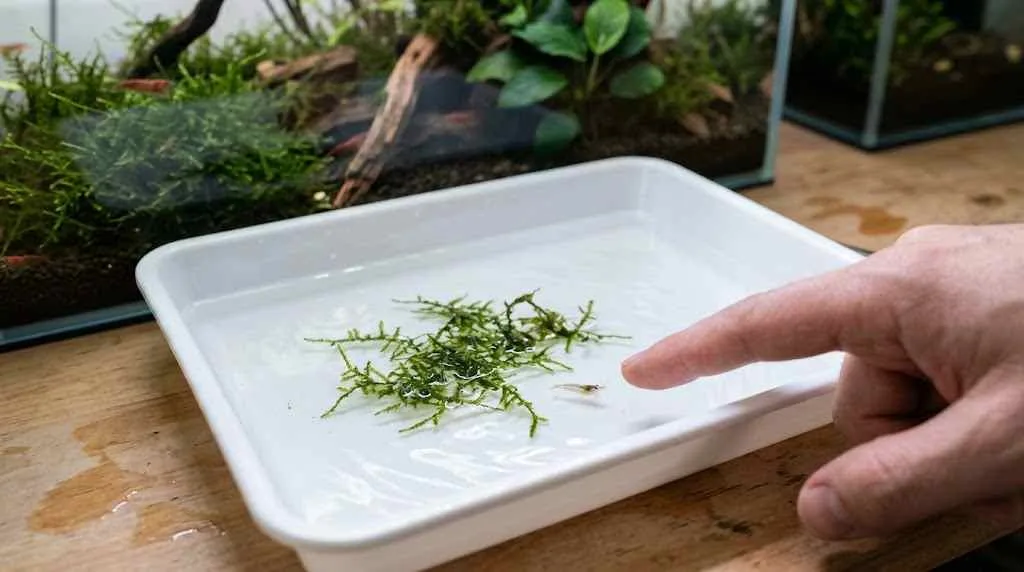
Before removing cuttings, check carefully for juveniles among the branches. Work over a container of aquarium water so accidentally collected shrimp can be spotted and returned gently.
Different mosses have different growth habits and demands. A decorative branching pattern alone does not establish that another moss will perform like Java moss.
Use the Java moss attachment and trimming guide — Java Moss Care: Attachment, Trimming and Shrimp Habitats] for the detailed method.
Rhizome plants: accessible surfaces without a planting bed
A rhizome is the thicker stem from which leaves and roots emerge. Java fern and Anubias can grow attached to hardscape, but their rhizomes should remain uncovered. Thin roots extending toward or into substrate are a different matter.
Anubias nana provides broad leaves that are relatively easy to observe. Java fern creates more upright structure. Place either so shrimp can move around the attachment point while you retain access to nearby equipment.
Do not assume every variety stays compact. A plant sold as “Anubias” may grow much larger than the particular nana form described here, while a standard Java fern can overwhelm a small foreground.
Slow growth usually reduces trimming frequency, but it does not remove nutrient needs or the need to inspect leaves. Attached plants are particularly useful when you want to avoid repeated disturbance of the planting substrate.
Rooted and stem plants
Rooted plants help create continuous cover between the substrate and taller features. Cryptocoryne wendtii ‘Green’ can serve this role where there is adequate room for the rosette and its roots.
Choose its position with future maintenance in mind. Moving an established rooted plant can disturb substrate and release trapped debris. In an occupied shrimp aquarium, relocation should be planned rather than treated as a quick decorative adjustment.
Stem plants suit keepers who want additional background structure and are willing to prune. Ludwigia repens offers branching growth, but rapid extension means more work, not automatically lower maintenance.
Keep the group reachable. A dense background pressed against the rear glass may be difficult to trim, inspect or clean without disturbing neighboring habitat.
For both growth forms, consider nutrient availability in the substrate and water. Rooted plants should not be treated as exclusively root-fed, nor should fish waste be assumed to supply every required nutrient.
Floating plants: hanging habitat with a shading cost
Amazon frogbit adds hanging roots and surface shade without occupying a planting bed. Those roots may offer surfaces and sheltered routes, but they do not establish that fish cannot reach shrimplets.
Review the surface before choosing floaters. Strong outlets may repeatedly submerge or displace them. A cover may limit space above the water, and roots may interfere with feeding or equipment access.
Thin growth according to the layout below. If submerged plants are becoming shaded or maintenance access is closing, surface growth needs reassessment.
Do not remove floating plants straight into the waste bin. Juveniles can remain among the roots, particularly when growth is lifted as a tangled group.
Check local restrictions before obtaining or sharing floating species, and never release surplus into natural waters. See selecting and controlling floating cover — Floating Aquarium Plants: Choosing and Managing Surface Cover].
Choose cover for adults and shrimplets separately
Adult shrimp need room to move beneath leaves, around wood and between plants. Very small juveniles can use finer spaces that adults cannot enter. Combining broad-leaved structure with some fine growth provides different kinds of access.
Place sheltered areas near grazing and feeding opportunities. One isolated clump at the opposite end of an exposed aquarium may not serve the intended purpose.
In a shrimp-focused colony, the aim may be accessible habitat with minimal disturbance. In a community aquarium, evaluate fish behavior independently. Dense planting cannot correct an unsuitable tankmate.
Do not use visibility as a survival measurement. Hidden juveniles may be difficult to count, while occasional sightings cannot establish that all young are surviving. Observe growth and activity over time without repeatedly dismantling their shelter.
What “shrimp-safe aquarium plants” should mean
The phrase needs two separate checks:
- Is the plant suitable for the intended aquarium?
- Is this purchased specimen appropriately sourced and prepared?
A familiar species name cannot answer the second question. Ask whether the plant was conventionally grown or tissue-cultured, how it was held afterward, and what treatments or preparation advice apply to that batch.
Supplier information varies. For example, one commercial grower explicitly declines to guarantee that its conventional stock is pesticide-free. That is a reason to obtain information about the actual source, not evidence that all conventional plants are contaminated.
Tissue culture begins under controlled laboratory conditions and can reduce some introduction concerns. However, an opened or compromised container and subsequent handling still matter. The production method does not guarantee successful establishment in every aquarium.
Rinsing can remove loose material; it is not a test confirming the absence of every residue. No fixed soaking or quarantine period should be presented as universal pesticide removal. If treatment information raises an unresolved concern, keep the plants separate while seeking clarification rather than testing them with shrimp.
For the full assessment, use quarantining plants before introduction — How to Quarantine Aquarium Plants Before Adding Them].
Preparing and placing plants
Use a short, repeatable sequence:
- Confirm identity and growth form. Verify suitability for full submersion, or surface growth where applicable.
- Review source information. Resolve relevant questions about treatments and holding conditions.
- Choose appropriate preparation. Follow source-specific guidance and a suitable quarantine plan.
- Remove transport materials appropriately. Separate pots, restraints and growing medium as the plant’s preparation instructions require.
- Plant or attach correctly. Keep rhizomes uncovered, anchor rooted plants appropriately and place floaters at the surface.
- Preserve access. Leave feeding areas, filter components and observation routes reachable.
- Monitor establishment. Check the plant and shrimp before making further changes.
Use aquarium-appropriate attachment materials according to their instructions. A treatment or adhesive suitable for one application should not automatically be assumed suitable for every plant or animal.
Some nursery-grown plants change foliage after submersion. Assess the growing point and new growth before removing leaves merely because they look different. Remove clearly decomposing material selectively; do not strip every imperfect leaf or assume all deterioration is harmless adjustment.
Maintenance without unnecessary disturbance
Maintain sections according to need rather than cutting back the entire habitat at once. Keep useful cover while restoring access where growth has become obstructive.
Collect clippings promptly into a light-colored container with aquarium water. Inspect both the material and water for shrimp before disposal. Apply the same check to removed floaters, moss and debris.
Keep growth clear of intakes and outlets. Plants should not be relied on as a substitute for appropriate intake protection.
Fertilization also needs a product-specific approach. Neither “all fertilizer is dangerous” nor “every aquarium fertilizer is suitable at any dose” is reliable advice. Check formulation, intended use, actual water volume and instructions. Trace copper in a formulated fertilizer is not equivalent to an unrestricted copper treatment; a manufacturer’s compatibility statement applies to its stated product and use.
Injected CO₂ is not necessary for every planted shrimp aquarium. Choose plants that fit your existing approach rather than adding equipment solely because a photograph shows faster or denser growth.
Practical plant combinations
These hypothetical examples assume established water conditions suitable for cherry shrimp and the selected plants.
Small aquarium with modest lighting: Combine a compact Anubias with a reachable Java moss patch. Keep open space for feeding and inspect moss for accumulated debris.
Colony aquarium emphasizing juvenile habitat: Use several connected patches of fine growth alongside rooted leaf cover. Preserve maintenance routes instead of filling every gap.
Community aquarium: Combine sheltered lower planting with taller foliage where it fits. Assess the fish separately and maintain a separation plan; extra plants do not resolve active hunting.
Limited replanting work: Favor plants attached to stable hardscape and omit stems that would need repeated renewal. Accept slower development and continue routine inspection.
Closing selection checklist
The best aquarium plants for shrimp are those that perform a useful function in conditions you can sustain. Before buying, confirm:
- Function: Does the plant add needed cover or accessible surfaces?
- Suitability: Do its mature size and growing requirements fit?
- Source: Is its identity and treatment information adequate?
- Preparation: Is there an appropriate introduction plan?
- Placement: Can shrimp use it while equipment and feeding areas remain accessible?
- Maintenance: Can you trim, thin and inspect it without repeatedly disrupting the colony?
Avoid relying on a “shrimp-safe” label, a quick rinse or dense planting alone. Choose manageable growth, maintain an appropriate feeding plan and inspect every removed plant before disposal.