Ghost Shrimp Breeding: Eggs, Larvae and Species Differences
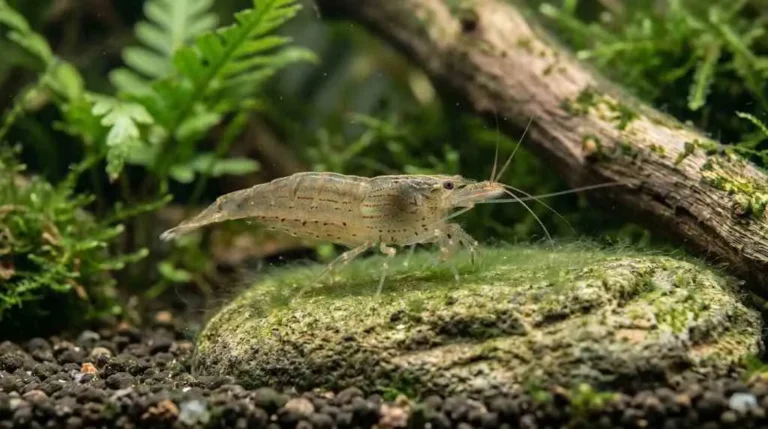
Ghost shrimp breeding begins with identification. “Ghost shrimp” and “glass shrimp” are aquarium trade names, so an egg-carrying female does not automatically tell you what water or food her young will require.
Can ghost shrimp breed in freshwater? Identified freshwater species such as Palaemon paludosus and Palaemon kadiakensis can complete development there. That answer must not be extended to every transparent shrimp sold under the same label. Their early development also differs: freshwater breeding does not necessarily mean that the young hatch as miniature adults.
This guide uses identified Palaemon kadiakensis for its worked rearing example because a detailed laboratory method documents development through metamorphosis. Information about P. paludosus is kept separate rather than folded into the same feeding instructions.
Table of Contents
Identify the shrimp before choosing a method
Ask the supplier for the scientific name, collection locality or breeder information. Establish whether the identification came from the original supplier or was simply assigned to a mixed shipment.
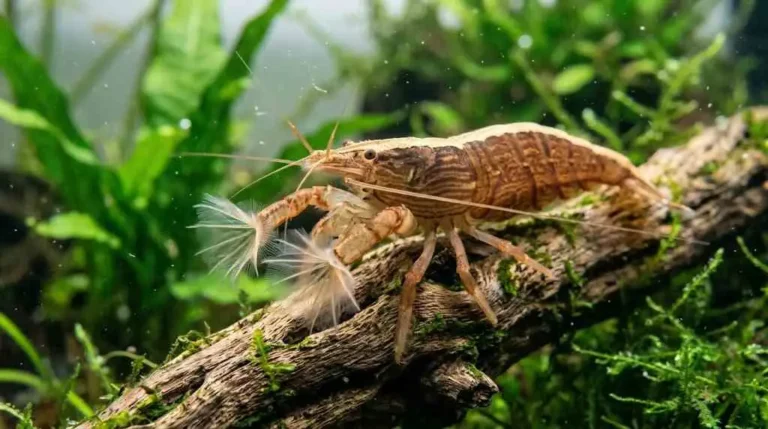
Useful photographs include a sharp side view of the head and rostrum, the walking legs and claws, and the tail fan. Include a size reference where possible.
Small anatomical features can matter. Published identification work distinguishes P. paludosus and P. kadiakensis using structures such as the position of a carapace spine and the arrangement of tail spines; the authors note that reliable separation requires magnification. A general shop photograph may not show these features.
Transparency, orange markings, egg color and body size can contribute observations, but none should be treated as a guaranteed species identification.
For the broader trade-name discussion, see ghost shrimp identification and adult care — Ghost Shrimp Care: Identification, Feeding and Tank Requirements].
Two freshwater species with different developmental needs
| Scientific name | Relevant common names | Supported developmental information | Important limit |
|---|---|---|---|
| Palaemon paludosus | Eastern grass shrimp; commonly called ghost or glass shrimp | Abbreviated larval development; published comparisons describe a non-feeding, yolk-supported larval phase | Do not assume that a feeding routine for another species applies |
| Palaemon kadiakensis | Mississippi grass shrimp; may be included under broad grass, glass or ghost shrimp labels | Freshwater larval development with an externally feeding phase | The worked method below applies to identified animals of this species |
If identification remains uncertain, record what you can observe and obtain help. Do not use larval losses as an experiment to decide whether the animals “must need salt.”
What does a “pregnant ghost shrimp” look like?
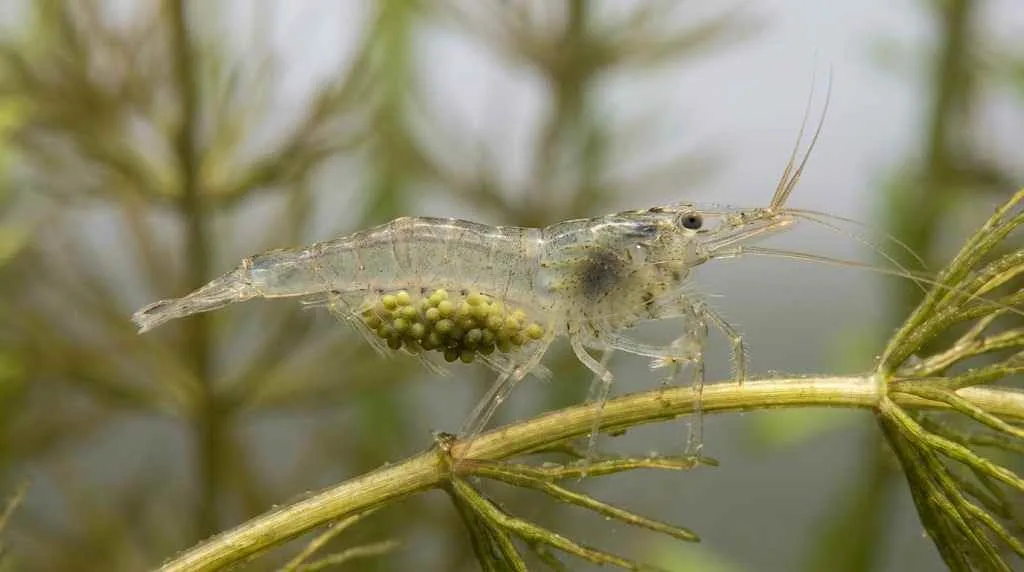
“Pregnant ghost shrimp” is common aquarium wording. An animal carrying eggs externally is more accurately described as egg-bearing, ovigerous or berried.
Distinguish two locations:
- Developing ovaries are inside the female’s body.
- Carried eggs are attached beneath the abdomen among the swimming appendages, called pleopods.
An internal colored patch is therefore not the same observation as an external clutch.
Photograph the female without repeatedly catching or turning her. Record when eggs were first noticed and whether their appearance changes. If the spawning date is unknown, the first observation is not the beginning of incubation.
Egg color alone cannot establish fertilization, viability or an exact hatch countdown. Likewise, disappearing eggs could reflect hatching, loss or another event. Check for young before deciding what happened.
An unfamiliar growth should not be diagnosed as eggs, disease or a parasite solely from its color.
Breeding-readiness checklist
Before planning a hatch, confirm that you have:
- The best available species identification.
- A rearing method appropriate to that species.
- Suitable adult conditions and mature animals.
- A prepared hatching and nursery arrangement.
- Food available before feeding begins.
- Safe collection tools and protected water intakes.
- Relevant water tests and prepared replacement water.
- Time for observation, cleaning and recordkeeping.
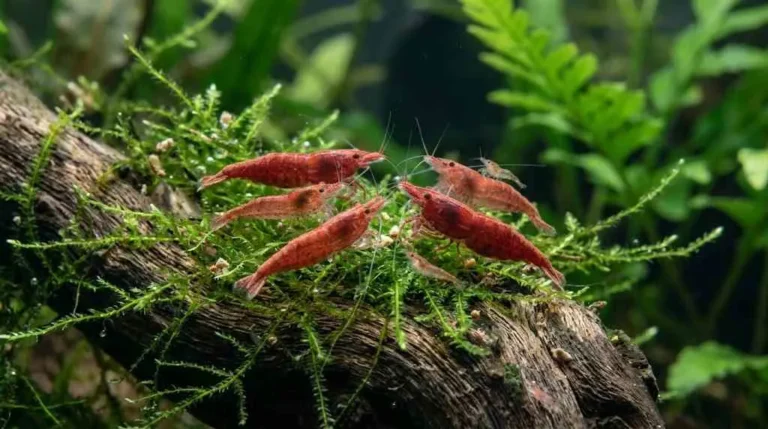
Experience with breeding cherry and Neocaridina shrimp — How to Breed Cherry and Neocaridina Shrimp] is useful for aquarium maintenance, but it does not establish the correct larval method for unidentified ghost shrimp.
A documented freshwater rearing approach
Broad and Hubschman reared P. kadiakensis larvae through metamorphosis using the following conditions together:
| Component | Documented laboratory arrangement |
|---|---|
| Water | Freshwater from Lake Erie |
| Temperature | Varied between 18.5–24°C / 65.3–75.2°F |
| Housing | Individual larvae in small glass culture bowls |
| Food | Daily day-old Artemia nauplii; a minority received lake plankton |
| Maintenance | Daily examination, bowl cleaning and fresh water |
| Handling | Large-bore pipettes |
| Outcome | Development to the postlarval juvenile stage |
The study also isolated females with advanced embryos for hatching. These are reported experimental conditions, not a universal home-aquarium optimum.
The practical guidance below follows that freshwater, live-food approach while identifying home adaptations. It does not borrow salinity changes from Amano shrimp or non-feeding larval assumptions from P. paludosus.
Step 1: Prepare adults and observe the clutch
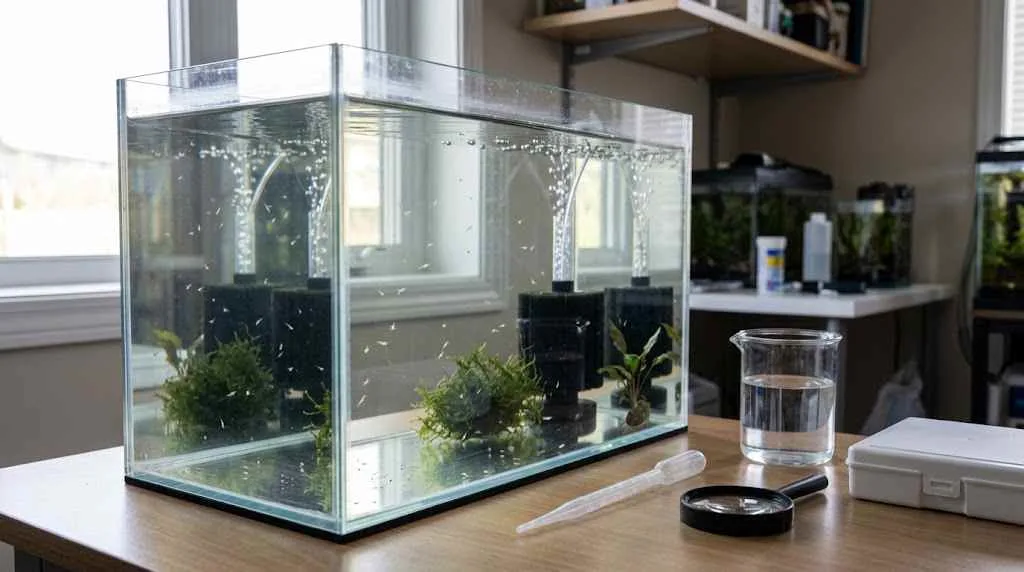
Maintain suitable adult care while preparing the nursery. Do not increase temperature abruptly, overfeed or add minerals and breeding stimulants simply because no eggs are visible.
Confirm that a planned breeding group includes mature males and females, but avoid assigning a compulsory sex ratio without evidence.
Observe an egg-carrying female through the glass. Useful records include the date, photographs, feeding behavior and any maintenance changes. These observations are more informative than repeatedly handling her to count eggs.
Keep the breeding attempt manageable. One clearly documented brood can teach more than several mixed broods whose identity, hatch dates and losses cannot be distinguished.
Step 2: Plan the hatching location
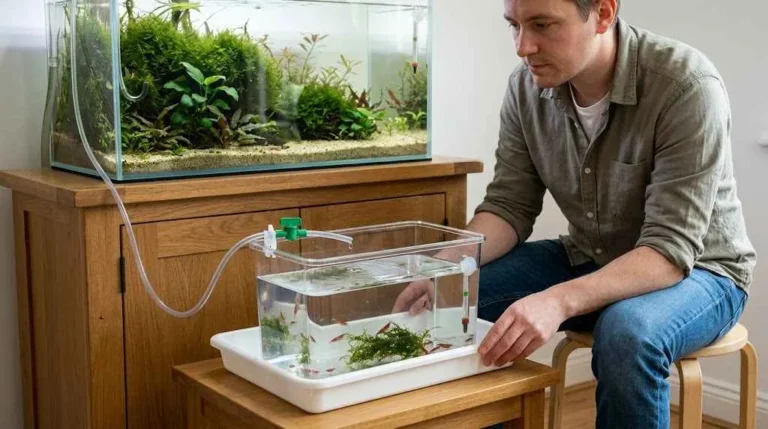
The laboratory reference used separate hatching containers. At home, a prepared freshwater hatching aquarium can improve observation and collection, but moving the female introduces handling and water differences.
Decide whether the existing aquarium allows safe collection. Consider its inhabitants, intake arrangement, vegetation and access. If a separate aquarium is needed, prepare it before moving the female.
Move her gently into suitable, comparable water. Do not transfer her repeatedly whenever the eggs change appearance.
After hatching, separating the adult from the nursery can simplify feeding and observation. This is a practical way to reduce interactions, not a claim that every adult inevitably consumes every offspring.
A breeder box is not automatically a nursery. Examine water exchange, openings, food retention and cleaning access rather than relying on the fact that it separates animals.
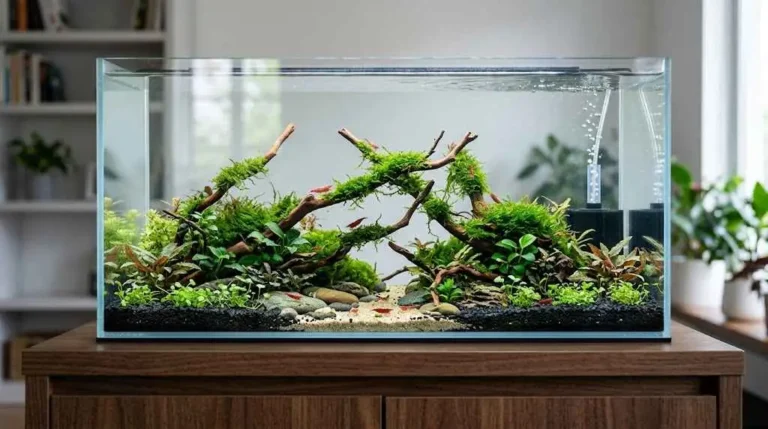
Step 3: Prepare a nursery you can maintain
For the identified P. kadiakensis approach, keep the nursery freshwater. No developmental salinity transition is part of this method.
Use water that is appropriately treated and suitable for the species. Characterize the source and aquarium water rather than assuming that clear water is ready for larvae.
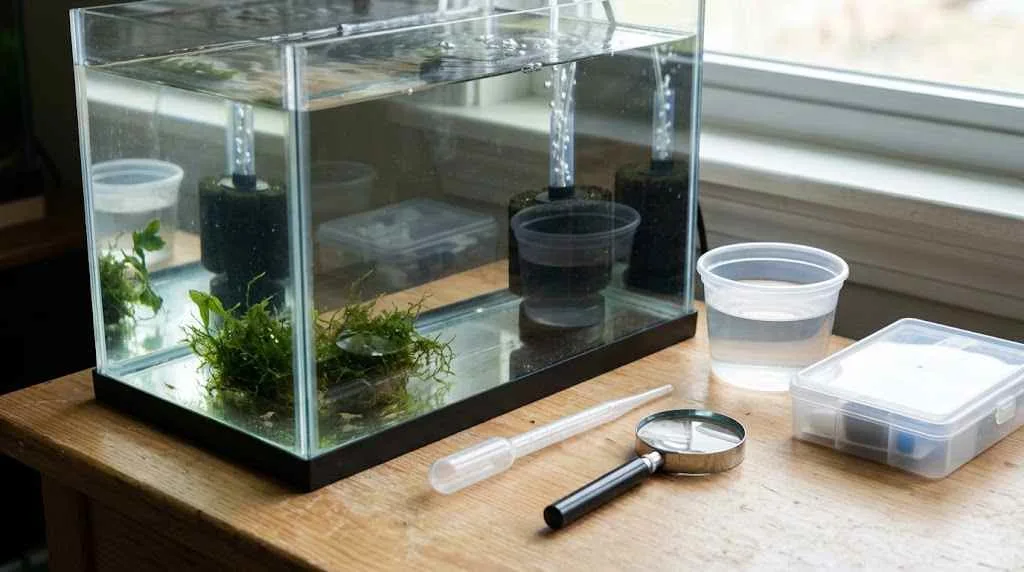
A small aquarium provides more working space than individual laboratory bowls, but it is an adaptation. For example, 20 liters, approximately 5.3 US gallons, describes a possible container size—not a verified minimum or stocking recommendation.
Arrange the nursery so that you can:
- Observe young against a clear background.
- Deliver food where they can encounter it.
- Inspect and remove accumulated debris.
- Check equipment without dismantling the habitat.
- Examine removed water before disposal.
Filtration and circulation
Protected filtration can help maintain a home nursery, but “shrimp-safe” equipment often refers to larger animals. Check openings, seams and suction against the actual size of the young.
Avoid flow that continually pins larvae against a surface or carries food directly into the filter. Assess the animals’ movement and feeding access rather than choosing an arbitrary pump setting.
See nursery filtration and intake protection — Filters for Shrimp Tanks: Sponge Filters and Intake Safety] for equipment considerations.
A filtered communal nursery does not reproduce the laboratory’s individual-bowl arrangement. It still needs its own observations of food distribution, waste accumulation and water stability.
Step 4: Prepare stage-appropriate food
The search phrase “ghost shrimp fry food” usually refers to food for larvae or juveniles. “Fry” is more commonly used for young fish; the developmental stage matters more than the label.
For the worked P. kadiakensis method, arrange a reliable supply of the live prey identified in the reference table. Do not assume that crushing an adult pellet produces an equivalent diet.
Preparing Artemia
Artemia are brine shrimp, commonly hatched from purchased cysts. Their hatchery is separate from the freshwater ghost shrimp nursery.
You need identified cysts, a clean hatching vessel, suitable aeration and lighting, and control of the hatching conditions. Follow the supplier’s instructions for that cyst product and confirm that a batch produces usable live nauplii before relying on it. Hatching performance depends on conditions and cyst quality.
Separate nauplii from empty shells, unhatched cysts and hatching waste. Harvest through suitable equipment and rinse before feeding; rinsing removes surrounding waste but does not sterilize the animals. Do not pour the hatchery’s saline water into the freshwater nursery.
Observe prey encounters and, where visible, capture and feeding. Food being present somewhere in the aquarium does not prove that every larva can obtain it.
No universal dose is supplied here: the reference does not establish a transferable number of nauplii per home aquarium.
Step 5: Maintain the nursery and follow development
Check the nursery at consistent times, recording:
- Temperature and equipment operation.
- Visible larvae or juveniles and their behavior.
- Food availability and access.
- Accumulated waste.
- Relevant water measurements.
- Cleaning or handling performed.
Use appropriate water tests and consistent measurement practices — Aquarium Water Test Kits: Choosing Tests and Reading Results]. Investigate unexpected readings rather than immediately adding chemicals.
Prepare replacement water before maintenance. Remove waste slowly with equipment that lets you see what is being collected. Inspect the receiving container and tools for young shrimp before disposal.
Do not interpret the laboratory’s complete bowl renewal as an automatic instruction to replace all water in a planted nursery. Housing, filtration and handling differ.
Development should be assessed through repeated observations. A missing animal may be concealed, captured in equipment or dead; visibility alone cannot establish which.
Step 6: Recognize and establish juveniles
In the P. kadiakensis study, postlarvae differed from larvae in structure and movement, including upright, forward swimming powered by the abdominal swimming appendages. A brief change of position is less useful than consistent behavior combined with magnified examination.
Do not move the entire cohort because one individual appears juvenile.
If young are already developing in a suitable nursery, transfer is not compulsory at metamorphosis. When more space is needed, assess the destination’s water, food access, intake protection and other inhabitants first.
Move juveniles gently with minimal chasing and inspect the transfer vessel afterward. Continue observing feeding and growth after the move.
There is no saltwater-to-freshwater transition in the selected freshwater method. Feeding Artemia does not change that.
As juveniles begin feeding on accessible surfaces and larger items, introduce appropriately sized foods cautiously and verify uptake. Do not assume that a food accepted by adults is immediately accessible to newly established juveniles.
Troubleshooting eggs, hatching and early losses
| Observation | Possible explanations | What to verify next | What it cannot establish |
|---|---|---|---|
| Eggs disappear | Hatching, egg loss or an event that was not observed | Photographs, nursery surfaces and intake areas | That all eggs hatched successfully |
| Larvae appear, then become difficult to find | Hiding, losses, capture or observation limits | Equipment, collection water and careful counts | A specific cause of mortality |
| Food remains available but larvae decline | Poor access, unsuitable food, water problems or incorrect identification | Species, stage, prey encounters and tests | That adding more food will help |
| Development appears slow | Stage uncertainty or unsuitable conditions | Repeated magnified observations and maintenance records | That salt or a stimulant is required |
| Young decline after transfer | Handling, receiving conditions or competition | Before-and-after records and destination suitability | One automatic diagnosis of “shock” |
| Egg appearance seems unusual | Normal variation or a problem needing assessment | Clear images and knowledgeable identification | A diagnosis from color alone |
Confirmed harmful water conditions require prompt attention. Avoid changing salinity, diet and equipment simultaneously unless an identified problem justifies those actions; otherwise, interpreting the result becomes harder.
Recordkeeping and the next practical step
Record identification evidence, egg observations, hatch dates, water conditions, food preparation, maintenance, handling and confirmed juvenile survival.
Keep separate records for eggs observed, larvae hatched and juveniles established. Report a survival percentage only when starting and subsequent counts were actually measured.
Before continuing, check that:
- “Ghost shrimp” has been narrowed to a defensible identification.
- The selected method matches the species and stage.
- Food is ready before it is needed.
- The nursery protects young while allowing maintenance.
- Development is assessed through observation, not a calendar alone.
- Any transfer has a suitable destination.
If identity remains uncertain, improve that evidence first. If identification is established, prepare the nursery and food supply before the next hatch. Those decisions make ghost shrimp breeding more useful and repeatable than trying a universal recipe after larvae have already appeared.